The hyena is the most misread animal in the Mara. The reputation she carries — scavenger, opportunist, second to the lion in everything that matters — is, in field terms, almost entirely the wrong way round. The spotted hyena is the dominant predator of the East African savannah by total biomass killed; the lion takes more from the hyena than the hyena takes from the lion; and on a quiet morning, the carcass the dawn discovers is statistically more likely to be hers than anyone else's.
What she is short of is theatre. The lion has a mane and a roar and a flag of a tail. The hyena has only the body and the work, and the work is what the rest of the Mara most often ignores.
The unfussy body
The hyena's body is built around a single principle: that no part of an animal is too tough to be eaten. The jaw exerts more force per square centimetre than any other land mammal — enough to crack the long bones of a giraffe and reach the marrow inside. The digestive system processes hide, hoof, hair, and bone with no part of it unused. A clan of hyena on a buffalo carcass can reduce eight hundred kilograms of animal to a patch of soil-stain in under twelve hours.
What this means for the picture is that the hyena is rarely far from food, and the food is rarely far from the hyena. The two are the same encounter. You photograph the kill and you photograph her; you photograph her and the kill is, almost certainly, somewhere in the frame.
The matriarchy
The spotted hyena is one of the few large mammals in which the female is, in every dimension, dominant. The matriarch outranks every male in the clan; the lowest-ranking female outranks the highest-ranking male; the rank passes from mother to daughter and is settled before the cubs are weaned. The males are immigrants, taken from neighbouring clans, who never reach the social weight of the females they live with.
A clan can hold sixty or eighty individuals, in shifting sub-groups that gather and disperse according to what the morning has produced. The den is the centre. The cubs born to the matriarch's line are nursed in the den for the first year of their lives, by their own mothers only — a hyena cub will starve before nursing from another female, and the dominance is preserved generation after generation by the simple arithmetic of who gets the milk.
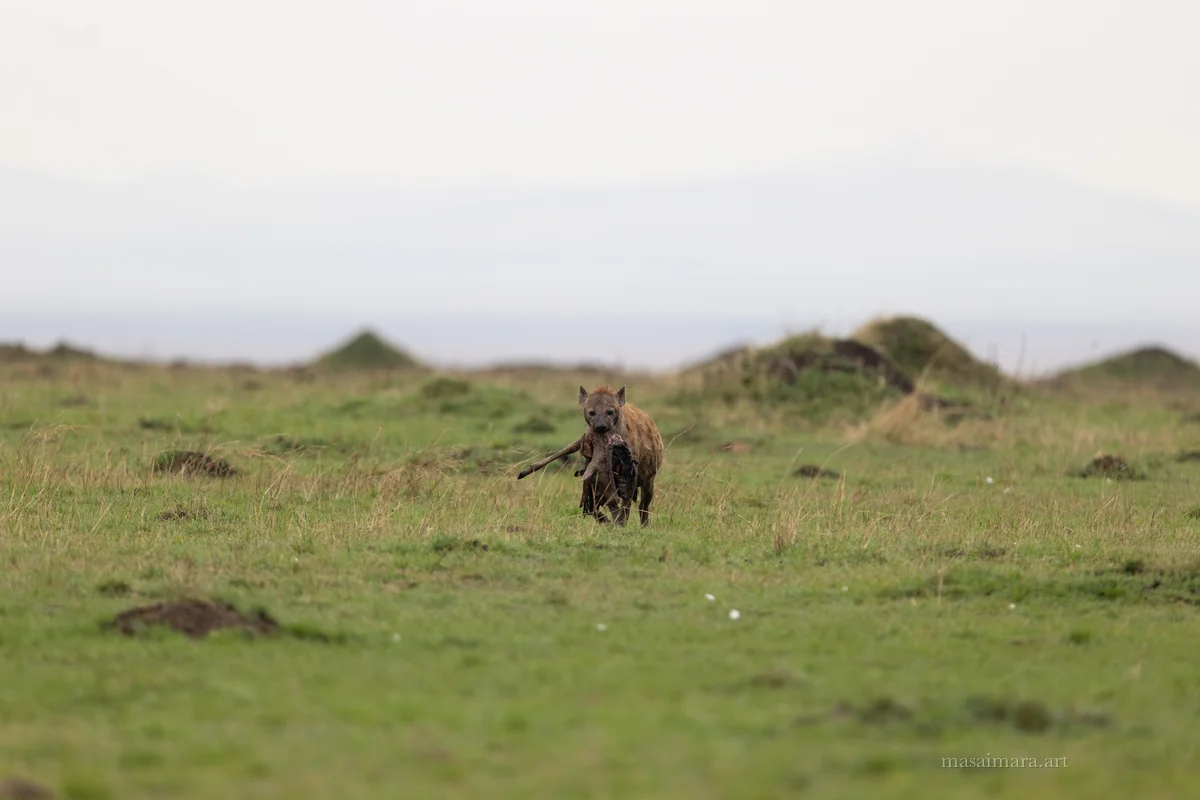
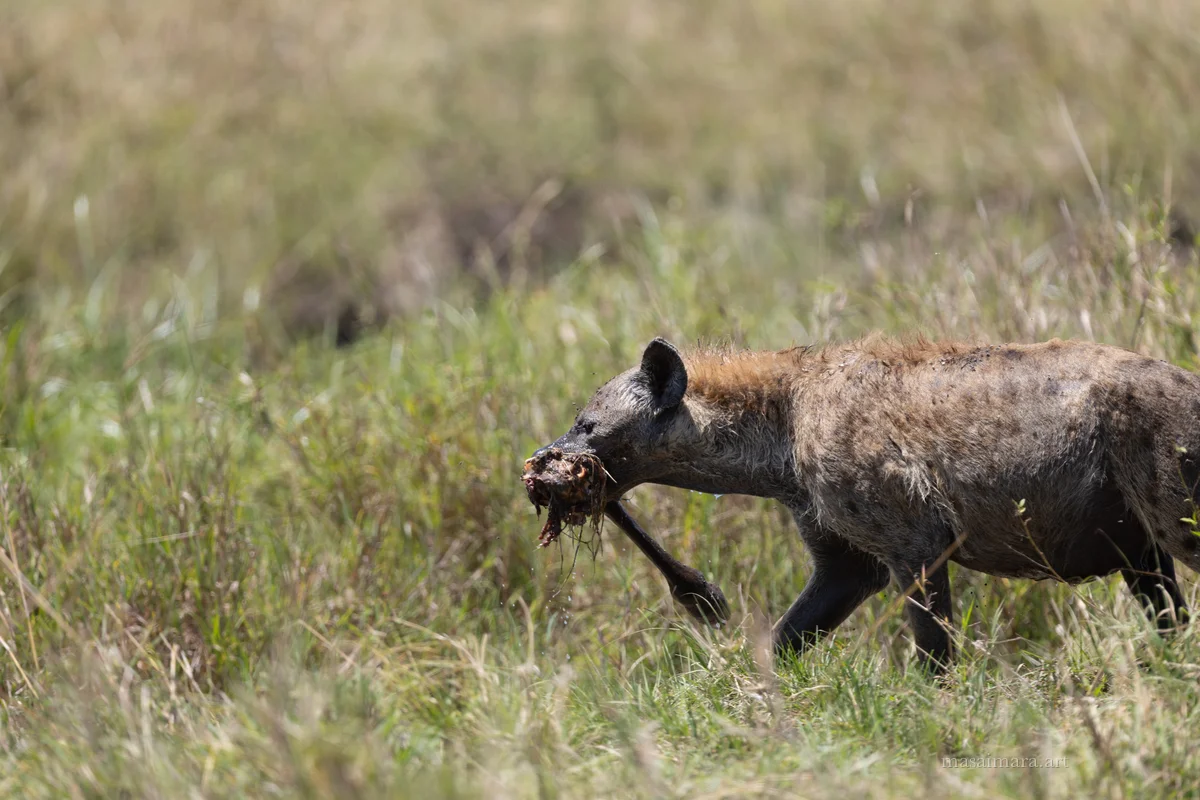
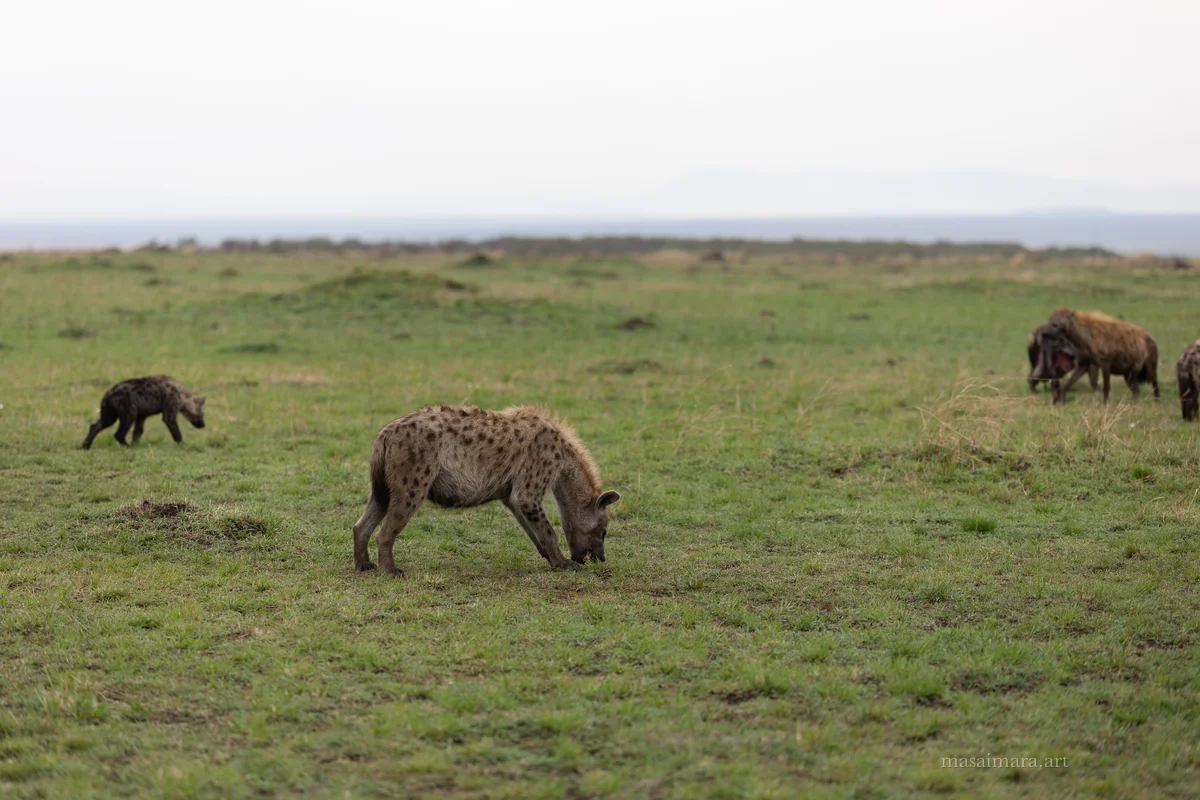
The carry — an adult hyena crossing green grass at distance with the prey in her jaws, head down, body long against the cover.
The kill that was not stolen
Decades of wildlife film treated the hyena as a thief and the lion as the killer. The numbers have, for thirty years, said the opposite. In the Serengeti–Mara ecosystem, roughly two-thirds of carcasses found at lions are kills the lion has taken from a hyena, not the other way round. The hyena is the more efficient hunter; the lion is the more efficient confiscator. Two adult lions can move a clan of fifteen off a wildebeest in under a minute.
The mistake was understandable. The hyena hunts at the edges of the photographable hours — first light, last light, through the night — and the lion arrives on the kill in the high morning, when the camera is on it. The picture finds the lion at the carcass and assumes the order of arrival. The hyena was first.
Field note — Working the newborn
The hyena is the predator most likely to take a newborn ungulate. At first light during the topi and wildebeest calving, she is most often found not at a carcass but at the edge of a herd holding new calves. She does not chase. She walks parallel to the line at a steady pace, head low, body forward, until something — a calf wandered, a mother distracted, a half-minute of inattention — opens a window. The window opens, statistically, in front of every herd at first light most days of the season. The hyena's working method is to be there when it does.
She is also one of the only predators willing to commit to a calf that is minutes old, still wet, still on uncertain legs. The lion will not commit if the adults are close; the cheetah cannot risk the adult's kick; the leopard wants cover. The hyena commits, and the morning either closes or it does not — and either way, she has lost nothing the next dawn will not let her try again.
The den
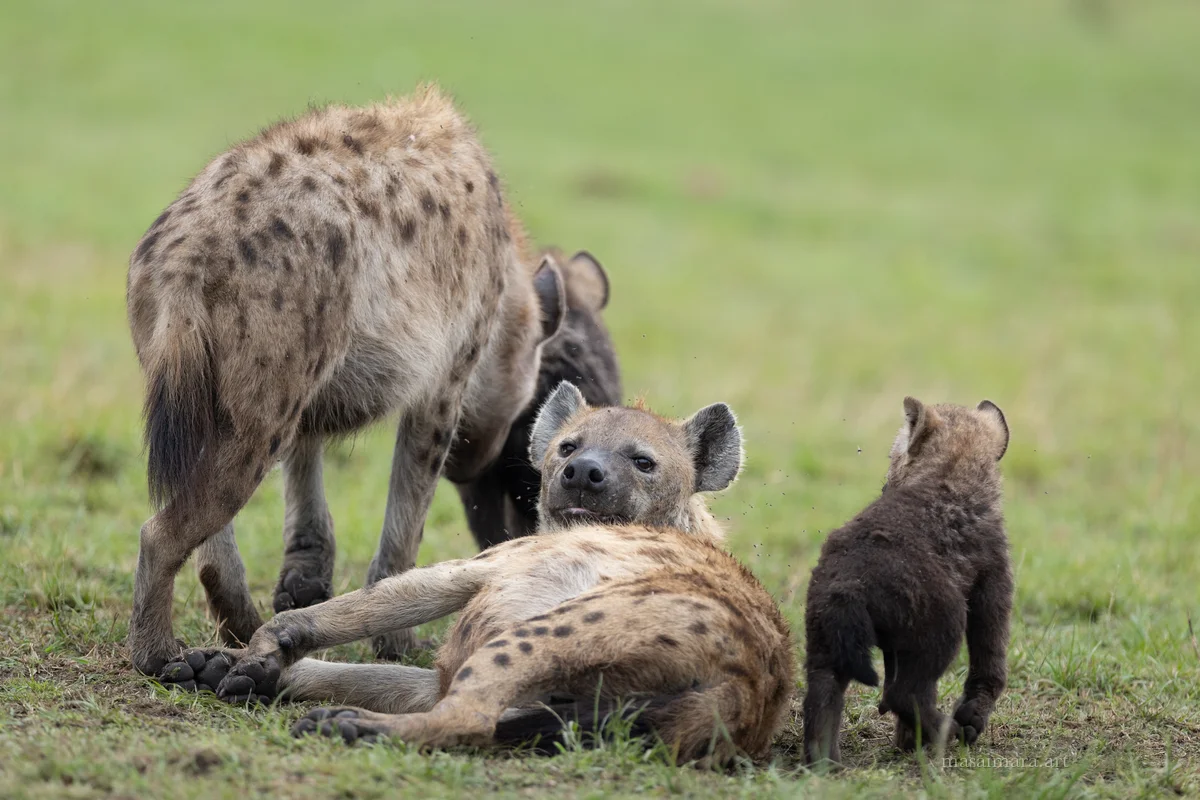
The den is the photograph the hyena story is most often missing. Cubs are born black — the spots come in over the first weeks — and emerge from the underground chamber at three or four weeks old, with eyes already open, already on their feet, already half the size of the adults at the entrance. The window for photographing them small is narrow; by twelve weeks they are difficult to tell from a yearling.
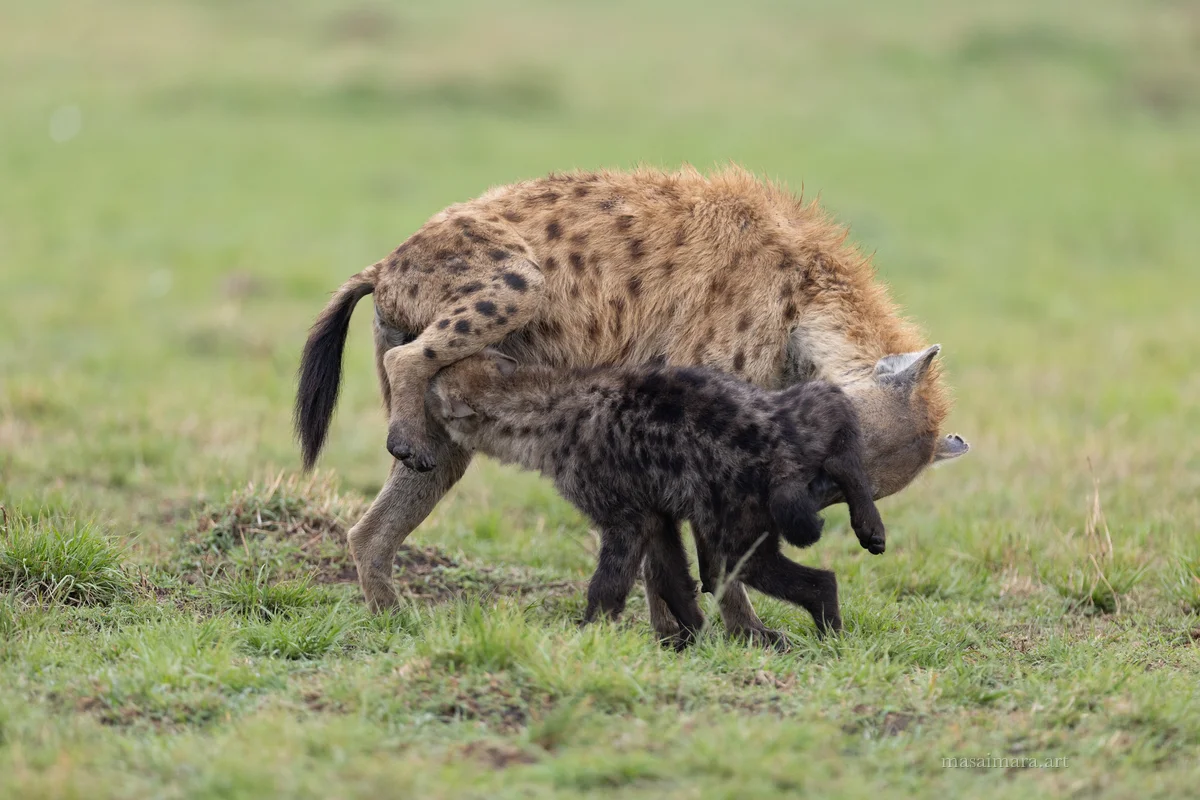
The den is also the only place the hyena's softness is photographable. An adult arriving with a piece of a kill is met at the entrance by cubs who press into her flanks while she lowers the cargo to them. A second adult settles in beside the first. Three animals around one body, the work done somewhere else, the family briefly composed as its own picture. The kind of frame the morning gives only once.
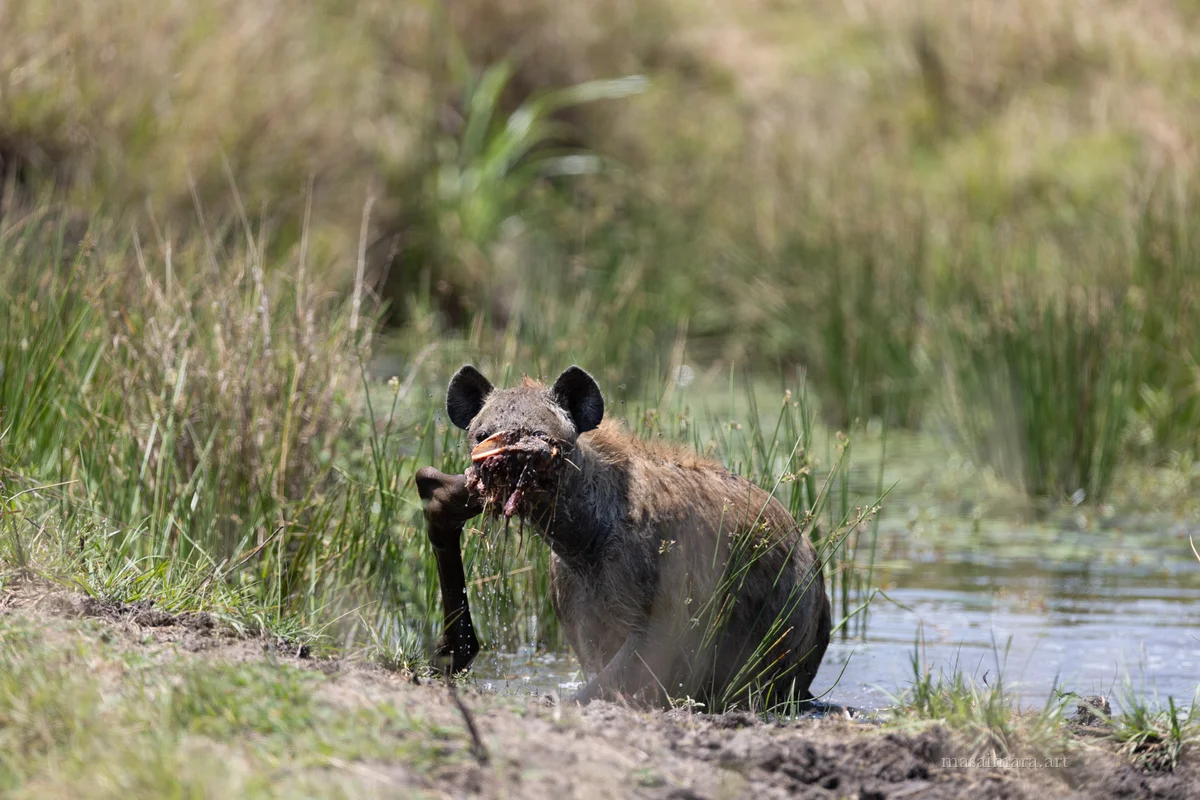
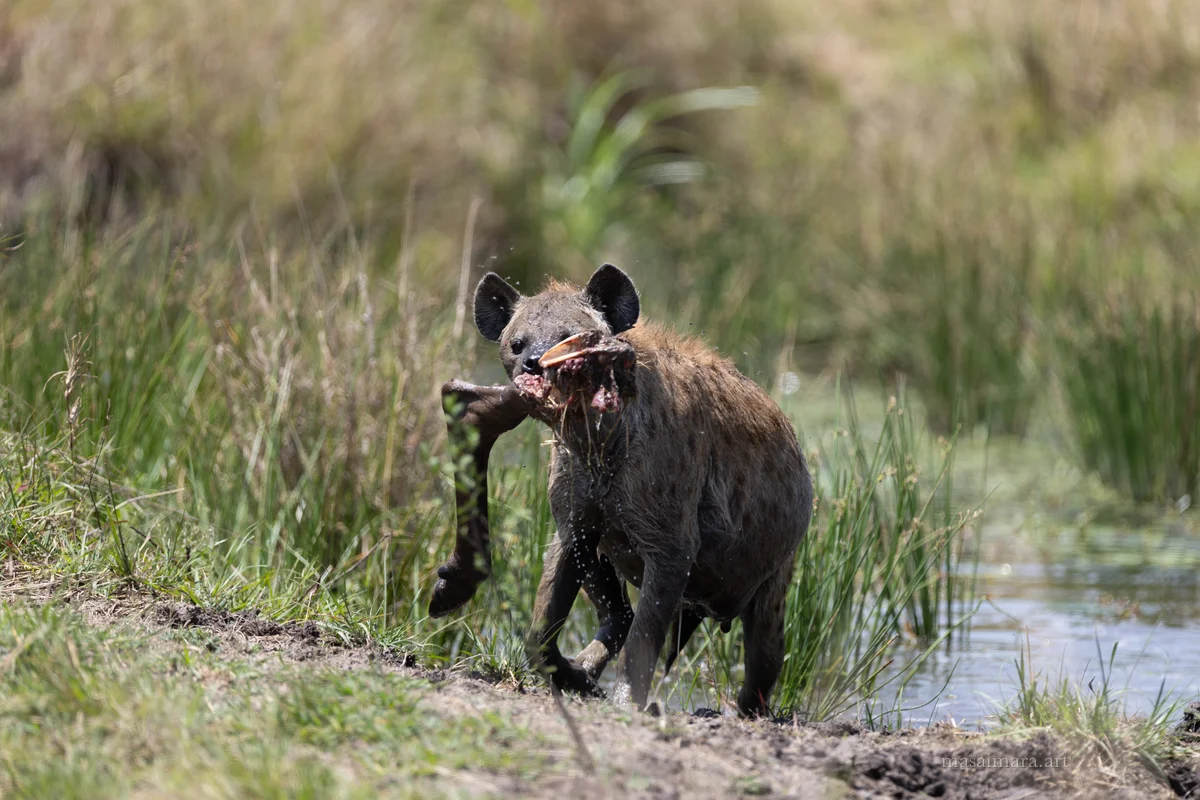
The two postures of a marsh hunt — submerged at the work, then up onto the bank with the prey held high, the body briefly between water and land.
The marsh hunter
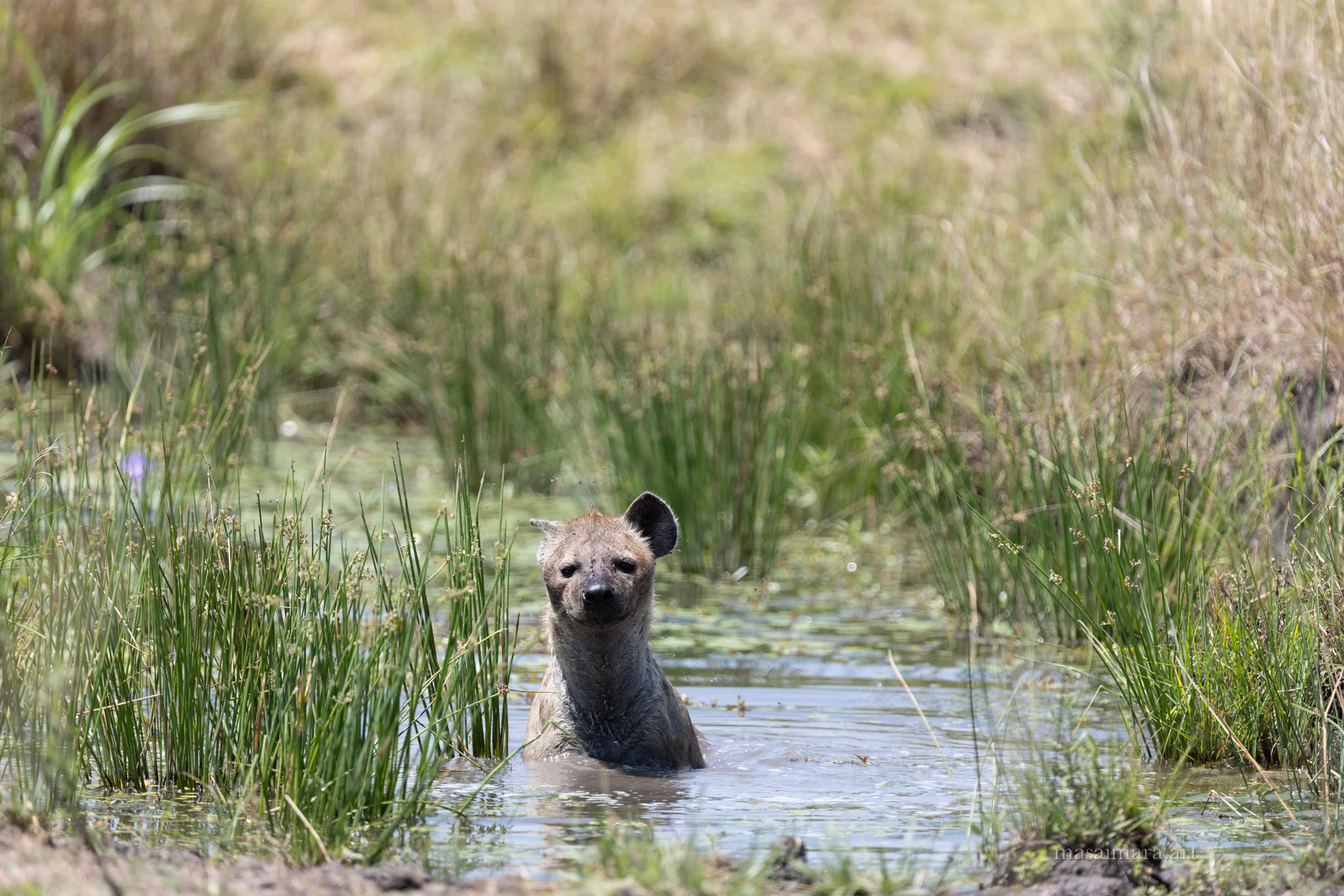
The spotted hyena is the closest thing the Mara has to an aquatic predator. She crosses streams without hesitation; she submerges in marshes to retrieve cached prey; she can stand for thirty minutes in chest-deep water working at something the camera does not get to see. The lion will not. The leopard will not. The cheetah cannot. The hyena uses water as a tool — both to hide a kill from rivals, and to cool a body that runs hot from the work of running prey down.
Most clans in the Mara hold a stretch of marsh inside their territories, and the strongest hyena pictures of any season come from these wet edges — half-submerged at first light, then the lift onto a muddy bank with the piece held high, the marsh fully behind her.
The clan at the carcass
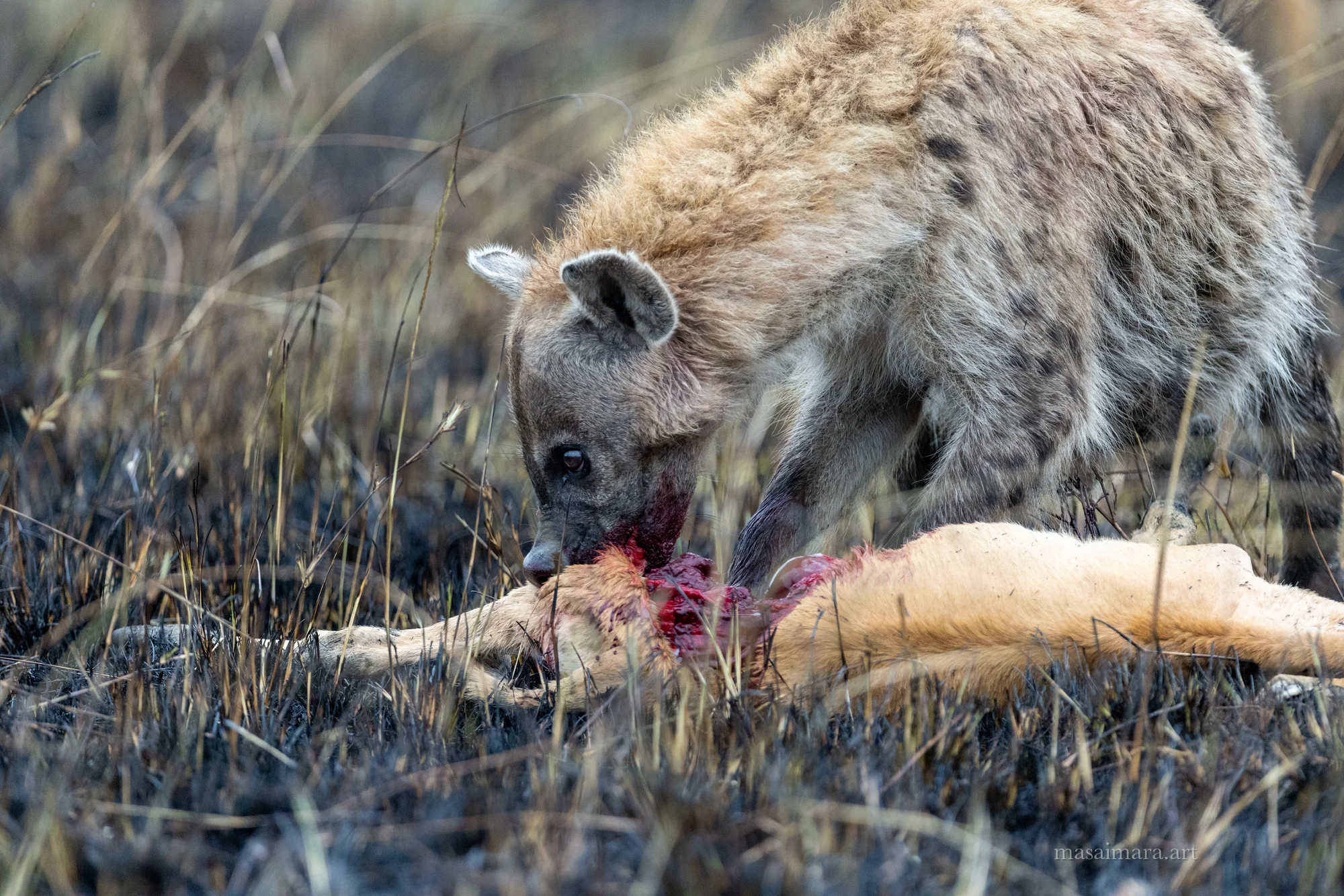
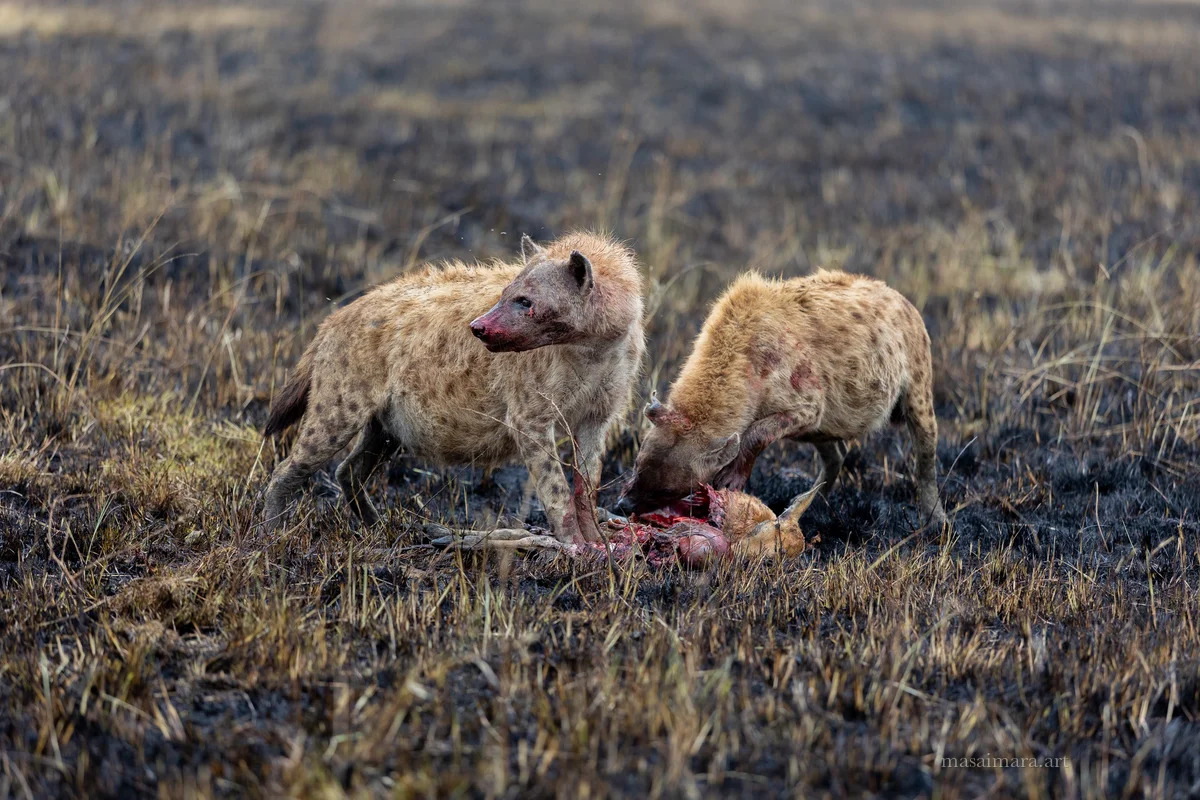
At the kill, the negotiation is loud, fast, and visually difficult to photograph well. Six or eight bodies pressed at the same point, blood at every muzzle, the small hierarchy of the moment changing every fifteen seconds. The picture does not compose. The lens, lifted, finds only mass.
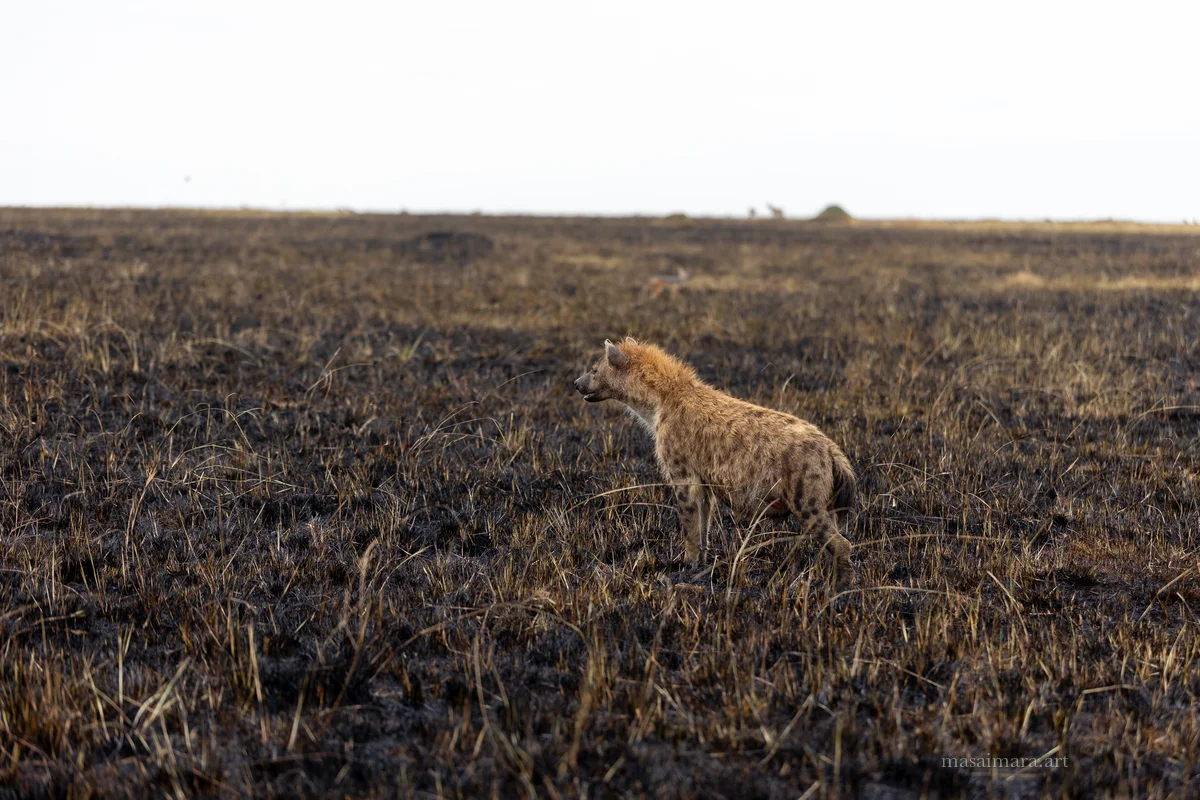
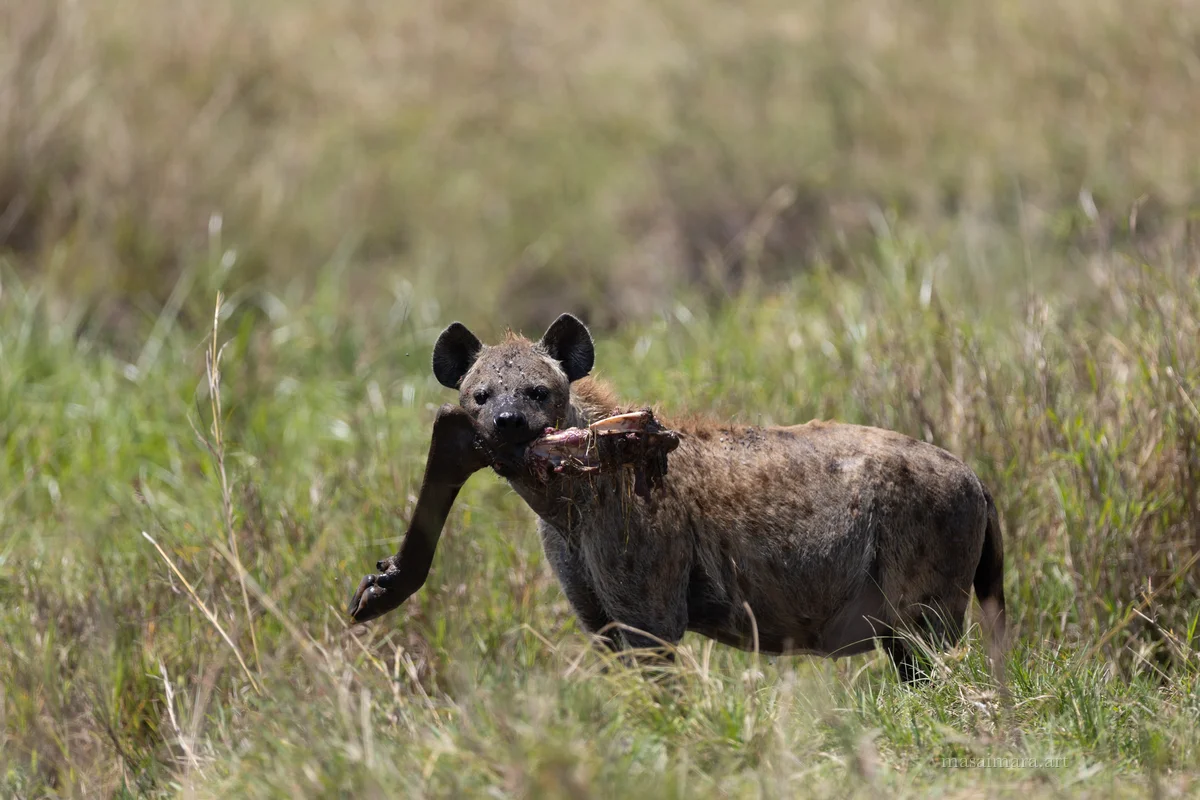
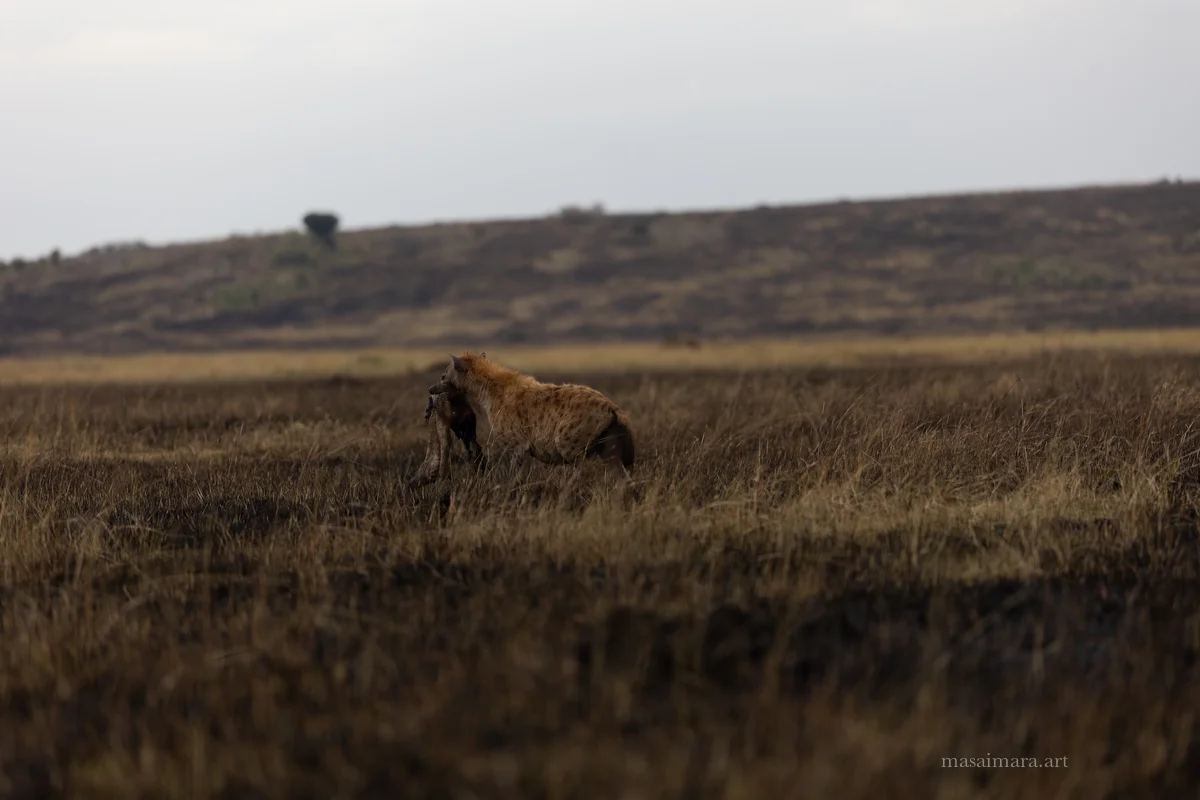
The frame the morning gives is the one outside the knot — the single hyena who has taken a piece and broken away, walking it across the burn or the open grass with the cargo dangling and the shoulders rolling in a slow steady stride. The clan stays. The piece goes. One hyena, one piece, one walk that does not end.
“The clan stays. The piece goes. The picture is in the walk.
”
Field notes
The pace
A hyena at full speed is among the most underestimated movers in Africa. She is not as fast as a cheetah and not as explosive as a lion, but she sustains a working trot of fifteen to twenty kilometres an hour for hours at a stretch. A clan running down a wildebeest does it across distances no other predator on the Mara can cover — sometimes eight or ten kilometres of working pursuit, the prey turning, the prey tiring, the prey eventually slowed.
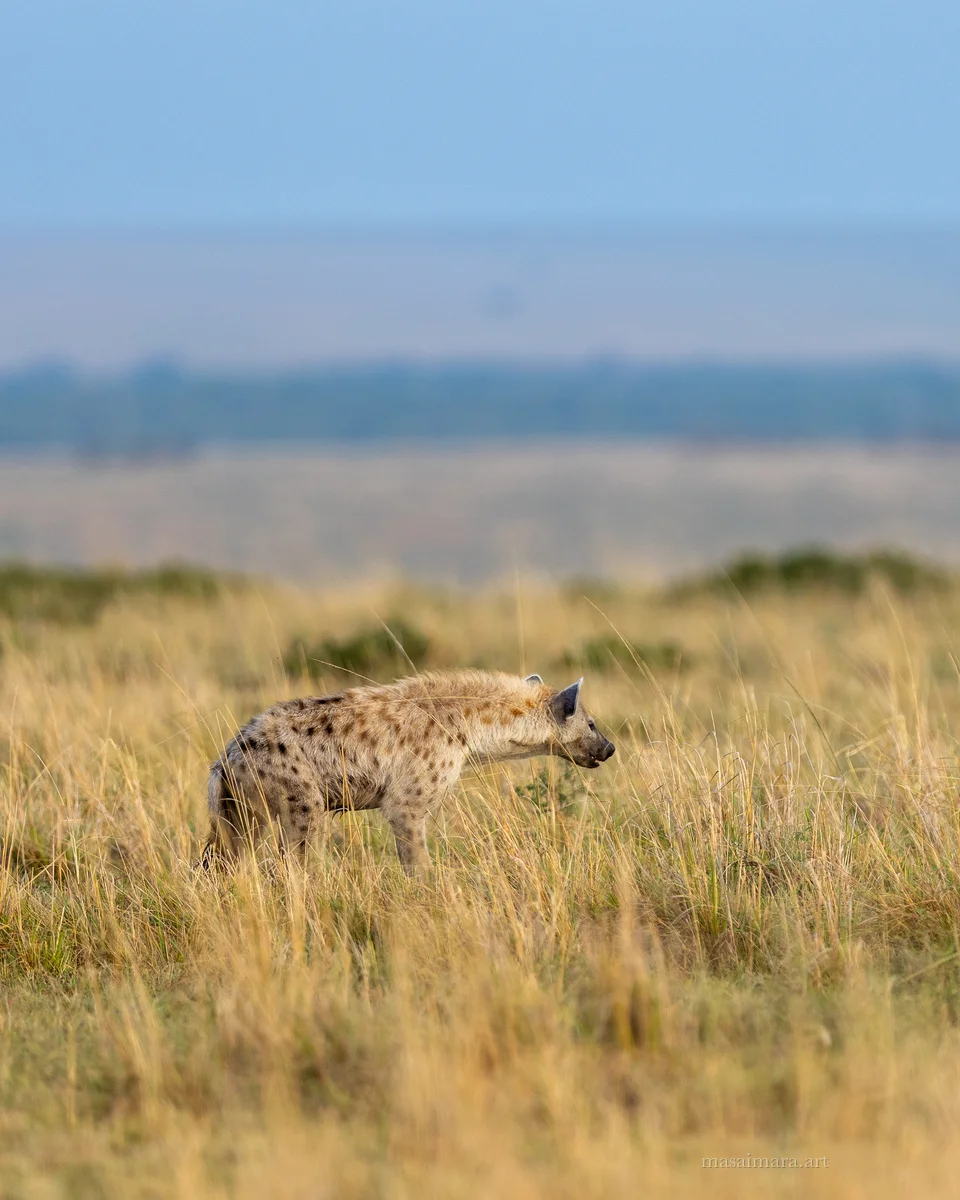
What the camera sees most often is not this. It is the working trot at dawn, the head low, the body moving forward through grass too tall to keep up with. The pace is unhurried. The pace is the point. The hyena is the only Mara predator whose hunting strategy is, in effect, being patient with her own legs.
The voice
What we call the hyena's laugh is, in field terms, a stress vocalisation — given when an animal is being driven off a kill, when a subordinate is being pressed by a dominant, when the clan is competing for a piece. The whoop, the longer rising call, is something else entirely. It is the contact call between members of a clan separated across the night plains, and on a still evening it carries five or six kilometres.
The whoop is the sound the Mara has at dusk. The lion roars at last light to declare a territory; the hyena whoops because the rest of the clan is somewhere ten kilometres away and the body needs to know where it is. The two sounds are the soundtrack of the same hour, but only the lion's gets the headline.
Delivery
Marsh
The Burn
Delivery
Chase
The hyena finishes most mornings the way she began them — moving, head low, through grass the rest of the savannah has not yet woken into. The picture is the walk.
The hyena lives at the edges of every other picture in the Mara — the herd at first light, the marsh at hard light, the burn at full light, the den at the green hour. The walk away from the kill is her portrait.
- Camera
- Canon EOS R5 Mark II · EOS R6
- Lens
- Sigma 500mm f/4 · Canon RF 70–200mm f/2.8