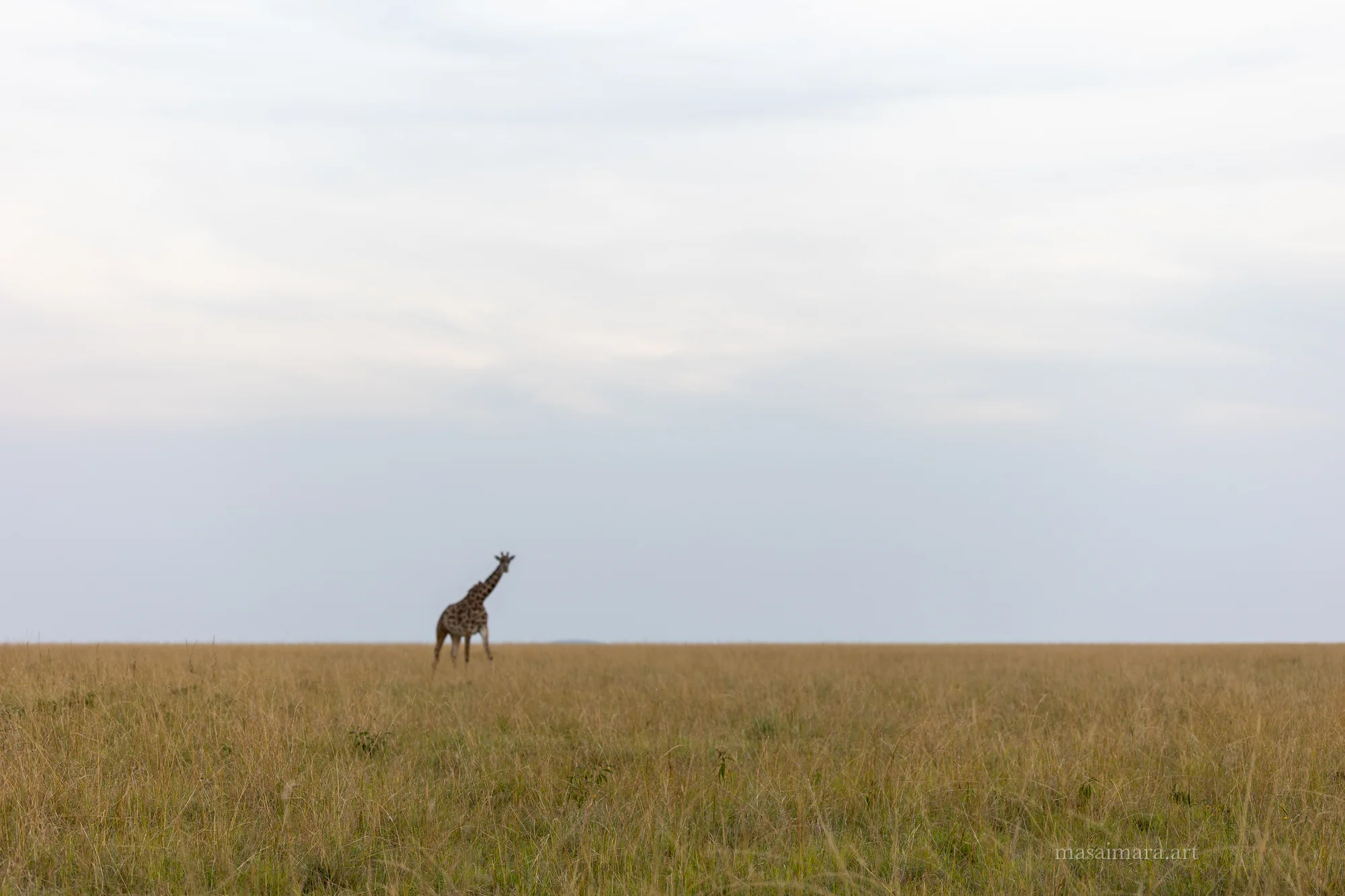
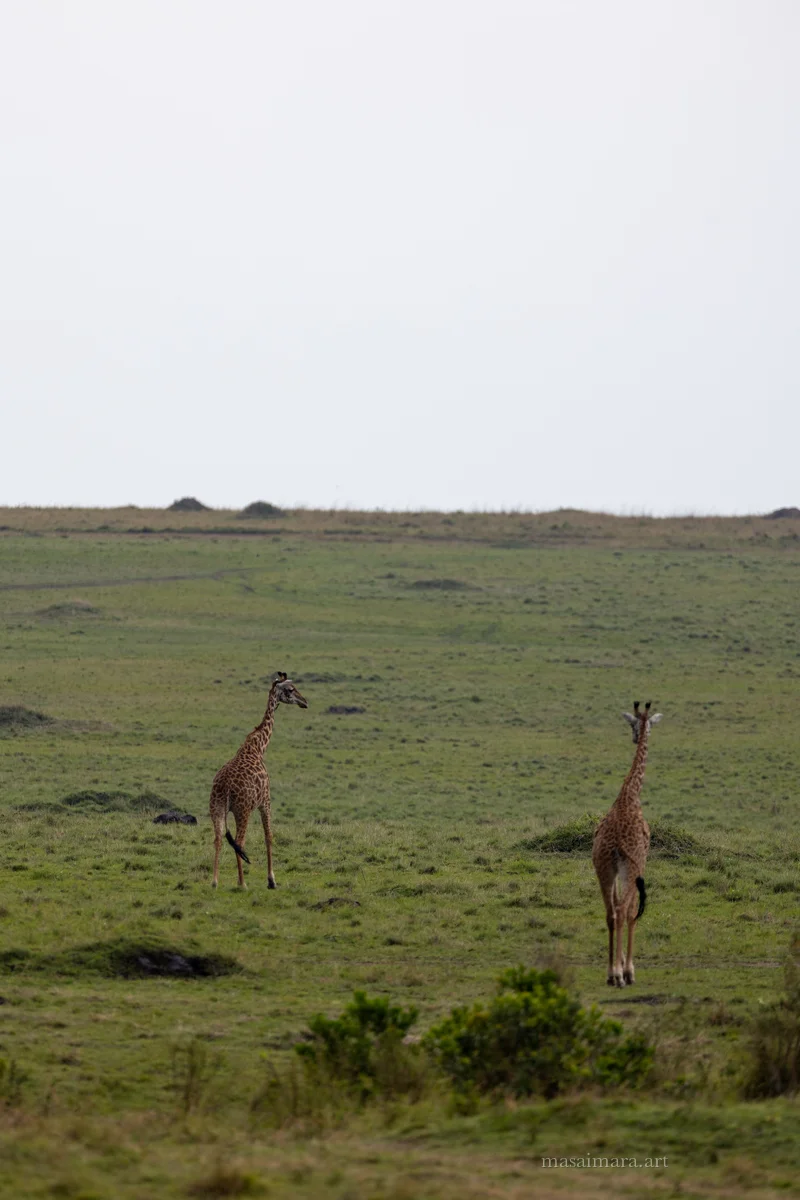
The giraffe is the only Mara mammal whose body belongs on the horizon. The lion, the elephant, the buffalo all need foreground; the cheetah needs a mound; the leopard needs cover. The giraffe arrives in the picture as a vertical line crossing the skyline, and the picture admits her without rearranging itself. Whatever else the afternoon was doing, the giraffe walks into it like she has always been part of the geometry.
What the picture does not always admit is how rare she is becoming. The Masai giraffe — the subspecies the Mara holds — has lost roughly half its population in the last three decades. The animal that reads as the most permanent fixture of the East African landscape is, by any modern population measure, the most slowly disappearing.
More tree than animal
The Masai giraffe browses for fourteen to eighteen hours a day. The food is sparse, the calories per leaf are low, and the body needs roughly thirty kilograms of plant matter to break even on the metabolic cost of being eighteen feet tall. The bulls take from the upper crown of acacias the rest of the bush cannot reach; the cows work the middle storey; the calves take what falls.
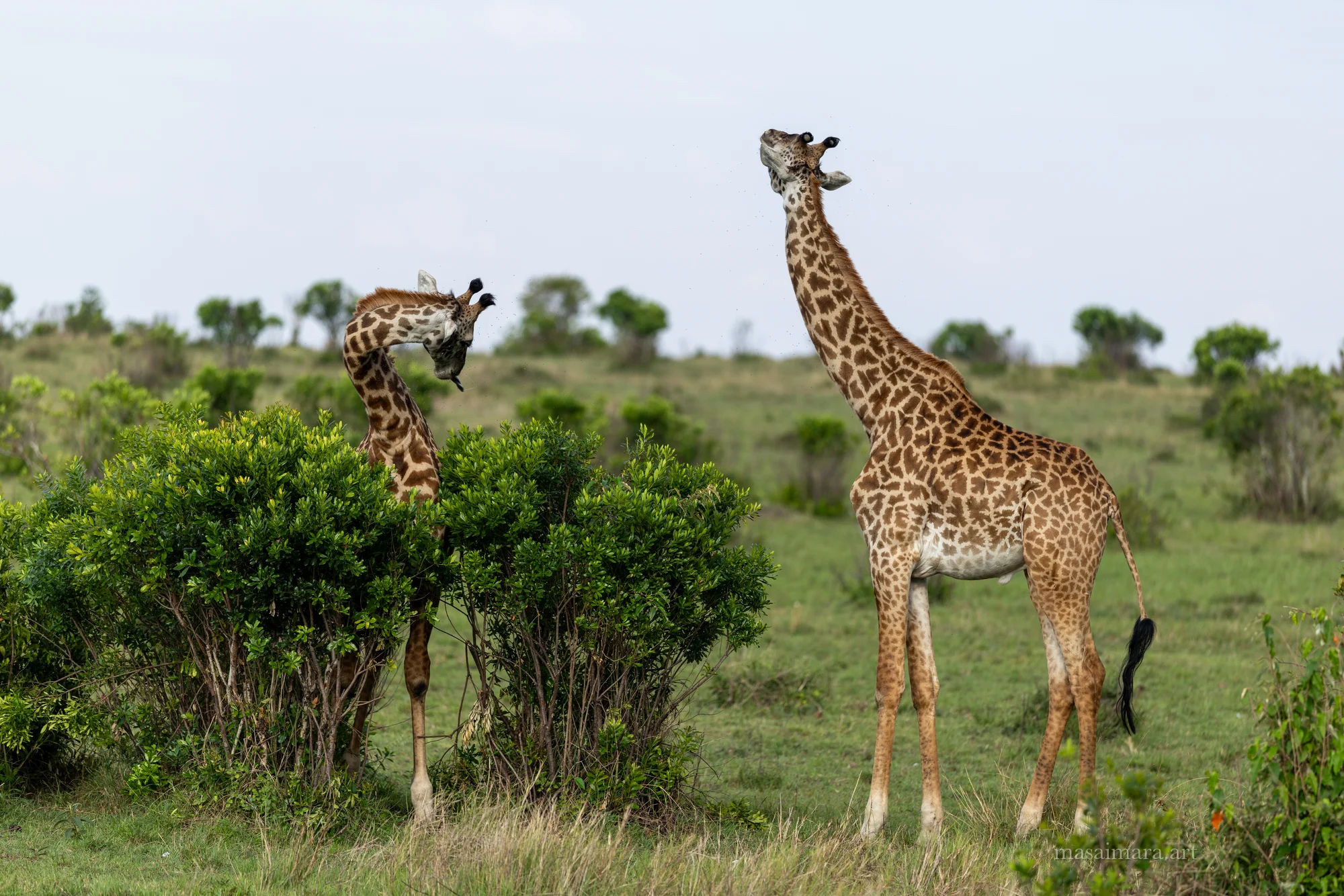
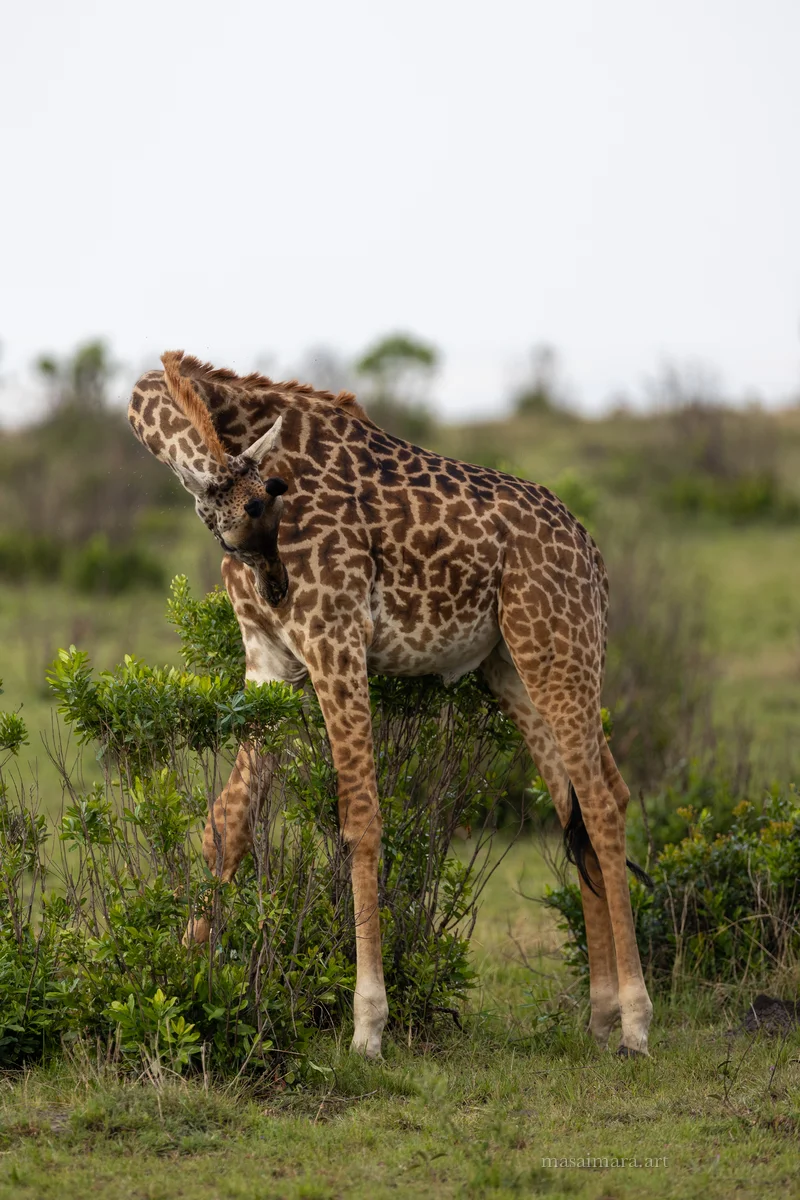
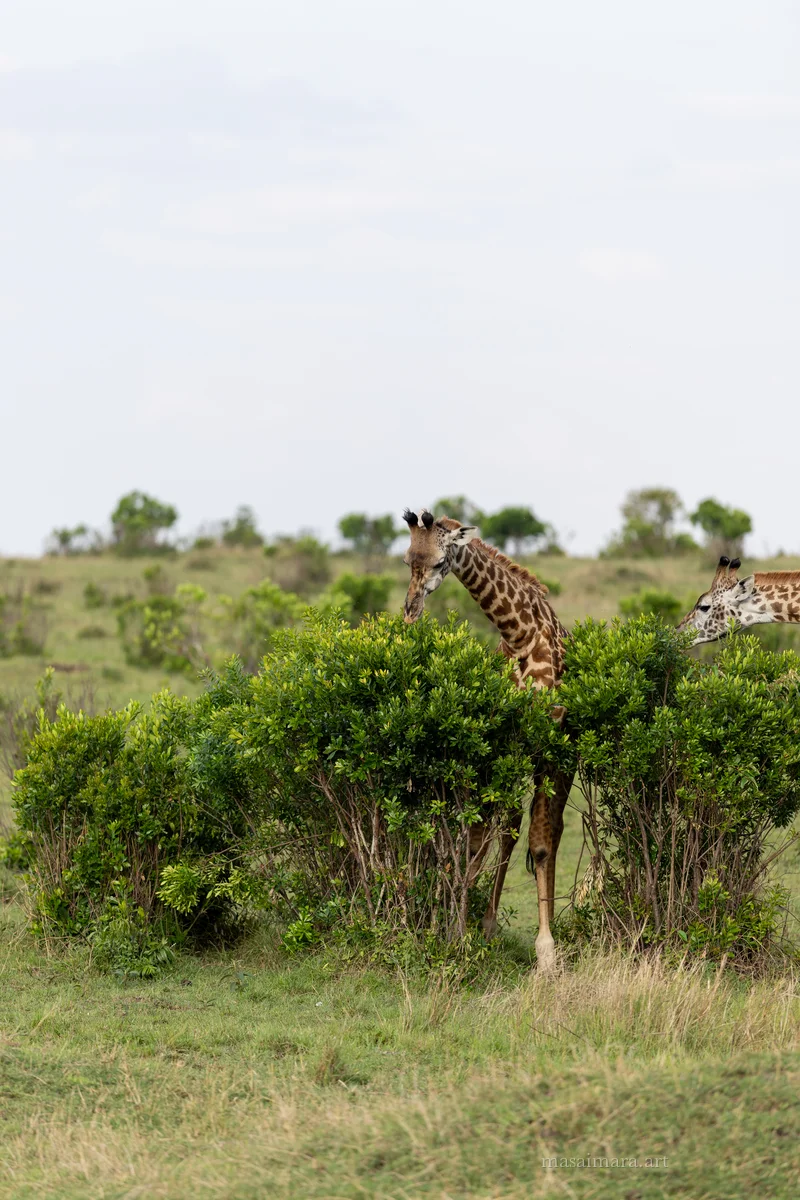
What this means for the photograph is that the giraffe at the bush is the giraffe most of the day. The head buried in the canopy. The long pale neck rising past the leaves. A second animal further along the same bush, paler in the haze. The bush is the centre of the picture; the giraffe is the bush's tallest leaf.
The herd that is not a herd
Giraffes do not herd in the way wildebeest or buffalo herd. The grouping is loose, fluid, and reorganises hour by hour — animals join, leave, drift apart, and reassemble across a stretch of plain with no leader and no detectable boundary. The closest analogue is the elephant's "fission–fusion" grouping; giraffes use the same pattern but with much weaker family bonds. A mother and her latest calf hold close for a year. Beyond that, the social architecture is, to the field observer, almost transparent.
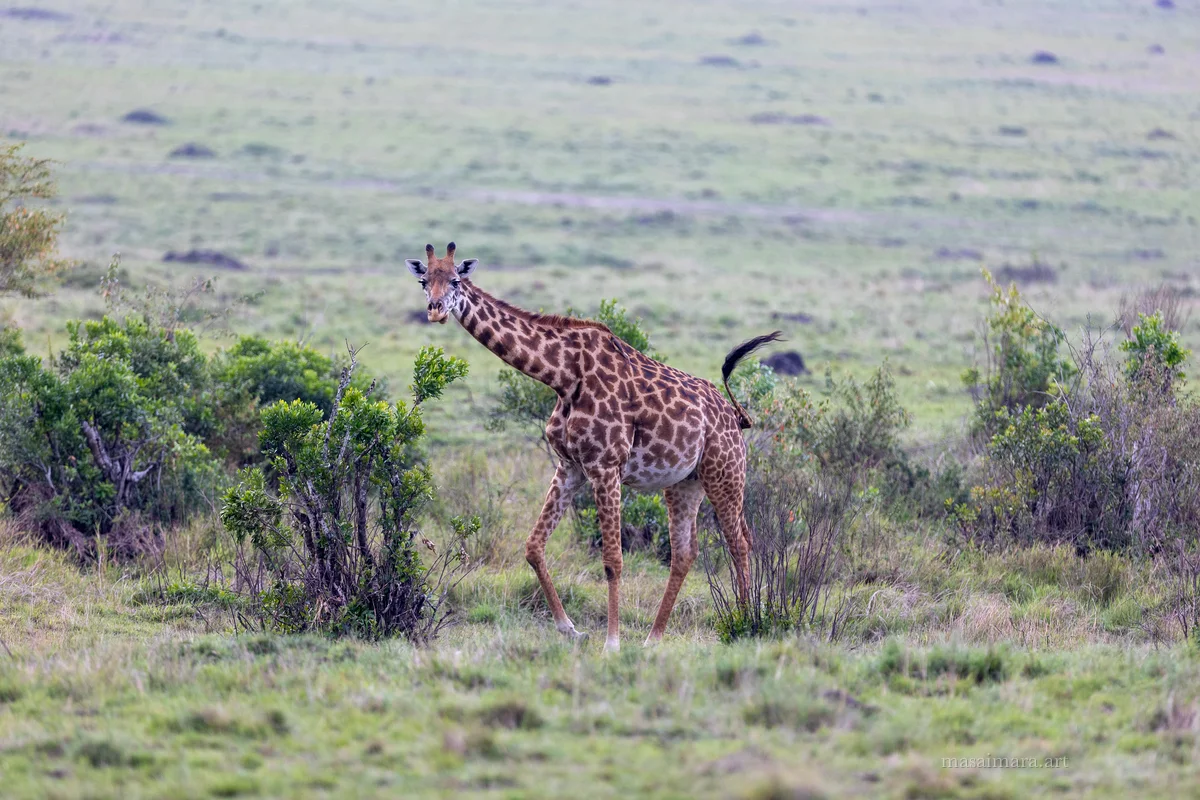
The photograph the afternoon gives is the photograph the moment makes — two animals turned the same direction, three at the same bush, one alone on the open. Half an hour later it is a different combination of the same animals, in a different room of the same plain.
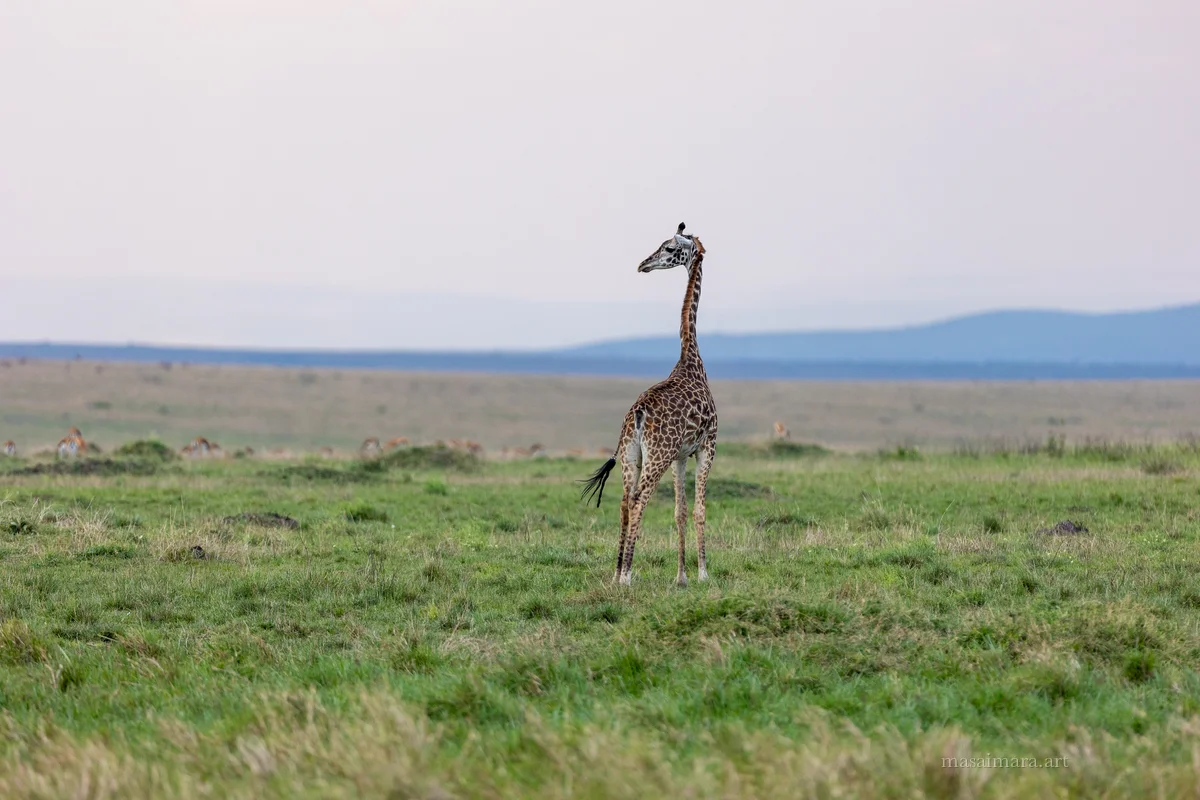
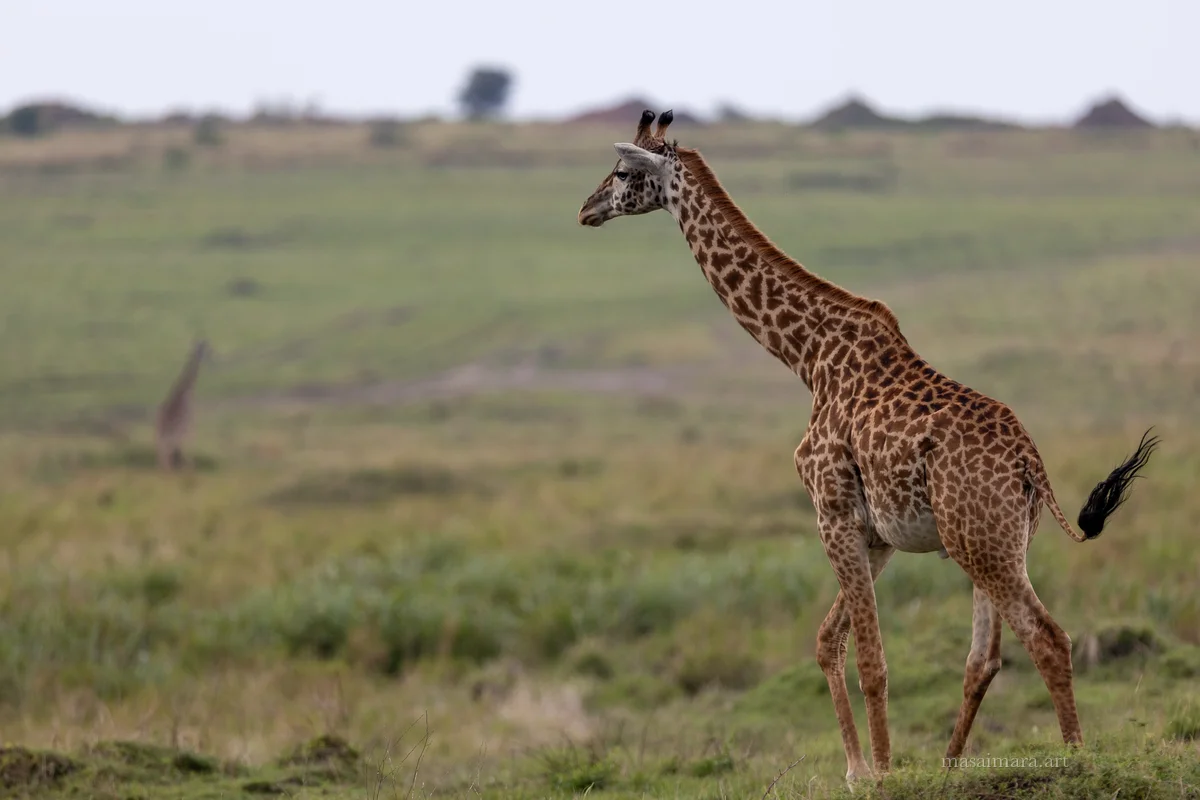
Head against distant pale hills, a thin line of antelope along the edge — the rest of the field finally allowed to share the picture.
The neck
The neck is the most-studied piece of giraffe anatomy in the world, and the most-misunderstood. The popular story — long neck evolved for long leaves — is partly right but not enough. The neck is also the bulls' weapon. Two male giraffes 'necking' is the closest thing the species has to a fight: the bodies braced side by side, the necks swung in long heavy arcs into the other's flank, the impact audible from a hundred metres away. A dominant bull's neck is, in working terms, his fighting limb.
What the camera sees most often is the result of the work, not the work itself. A bull with the slightly thickened crown of an older fighter, the ossicones worn smooth, the skin scarred at the chest from a hit that landed half a season ago. The fight is rare; the evidence is everywhere.
Field note — On the giraffe at dusk
An early Mara evening can hold a single giraffe alone on the middle of the plain, small and centred, head clear of the horizon, the sky behind her the colour of nothing in particular. The camera holds her there for two frames and she is gone.
The same plain, in the same hour, will often hold a male lion sprawled on his side in short grass, the body unguarded. The two animals share the plain without sharing a frame, and spend the hour ignoring each other. The adult giraffe is one of the few large mammals the lion considers neither prey nor threat — the legs are too long, the kick is too high, the energy is not worth the risk — and the indifference runs in both directions.
The horizon animal
The giraffe is the only Mara animal whose strongest portrait places her almost out of the frame. A wider lens, a shorter giraffe, an enormous sky, the blue hills past her shoulder doing more of the work than she is. The picture is the geometry of distance, of scale, of how much room the afternoon has agreed to give a single body — and the giraffe is the body the picture has decided to measure that room against.
There is no equivalent picture in the lion. The lion fills the frame. The cheetah, on a wider lens, is small but not measured. The giraffe is measured. The picture is, in the working sense, about how tall the afternoon has decided to be.
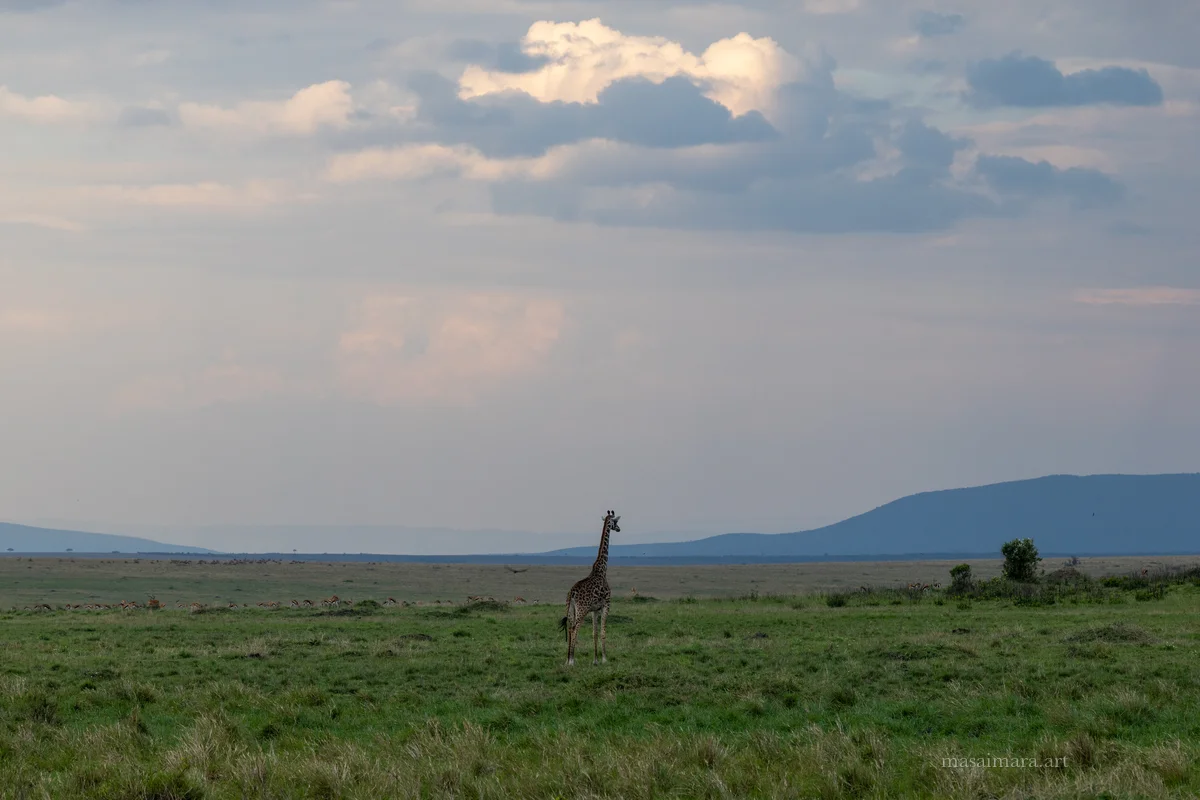
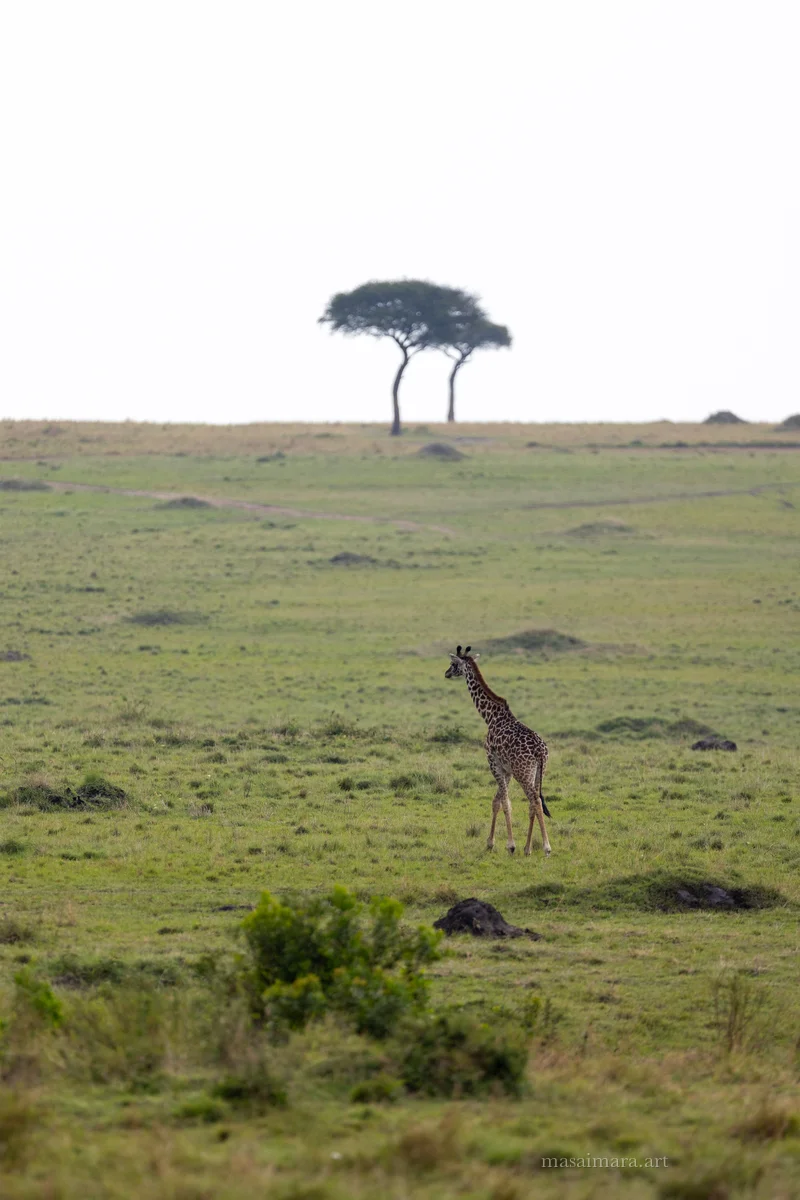
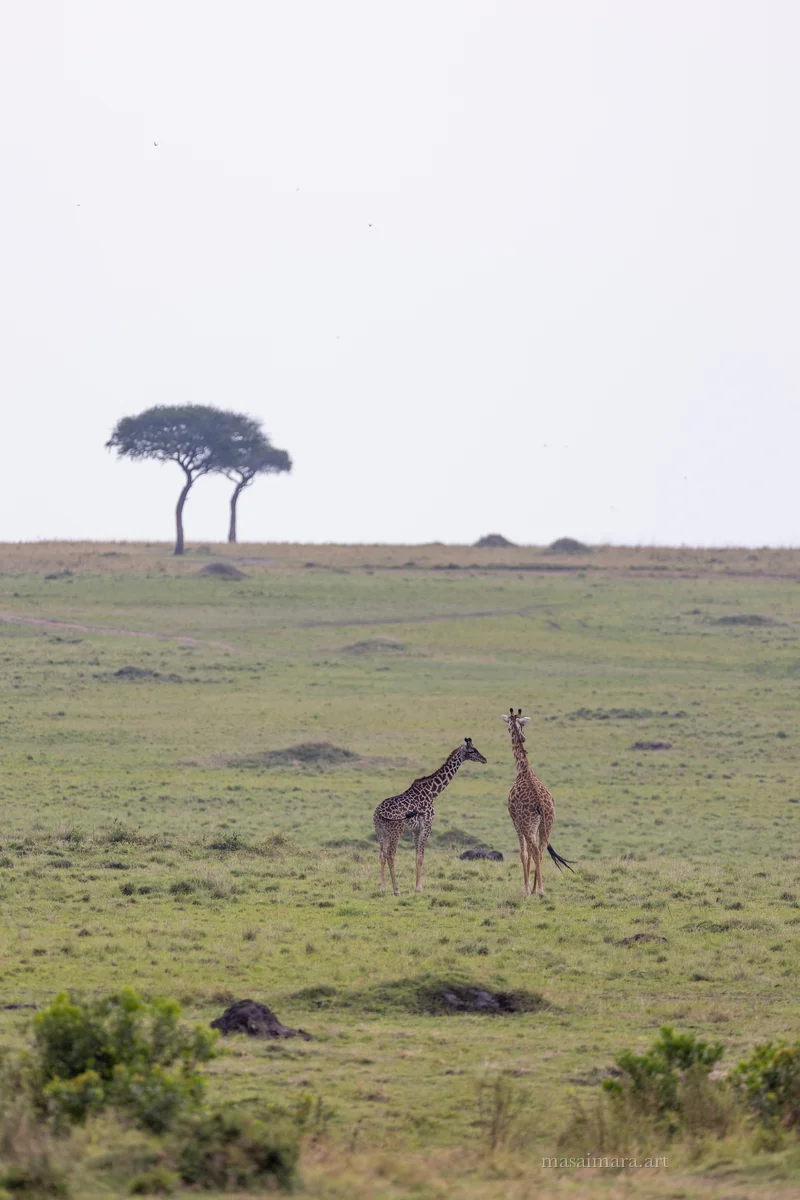
Two punctuation marks on the same line — the acacia first, the giraffes catching up. The two pairings of the same plain, ten minutes apart.
The pattern
The Masai giraffe is named for her coat — the irregular, jagged, leaf-shaped patches on a pale cream background, edges almost as ragged as the patches themselves. The pattern is unique to each individual; a population of fifty giraffes can be identified, animal by animal, from a clean side-on photograph of the neck. Researchers in the Mara have catalogued more than four hundred individuals this way, and the population's movement patterns are, in field terms, the catalogue plus time.
The pattern is also a thermoregulation system. The dark patches dissipate heat through a denser network of blood vessels just beneath the skin; the cream between them reflects it. In a Mara afternoon at thirty-eight degrees, a giraffe's surface temperature varies by as much as three degrees between patch and gap. The coat is air-conditioning. The pattern is plumbing.
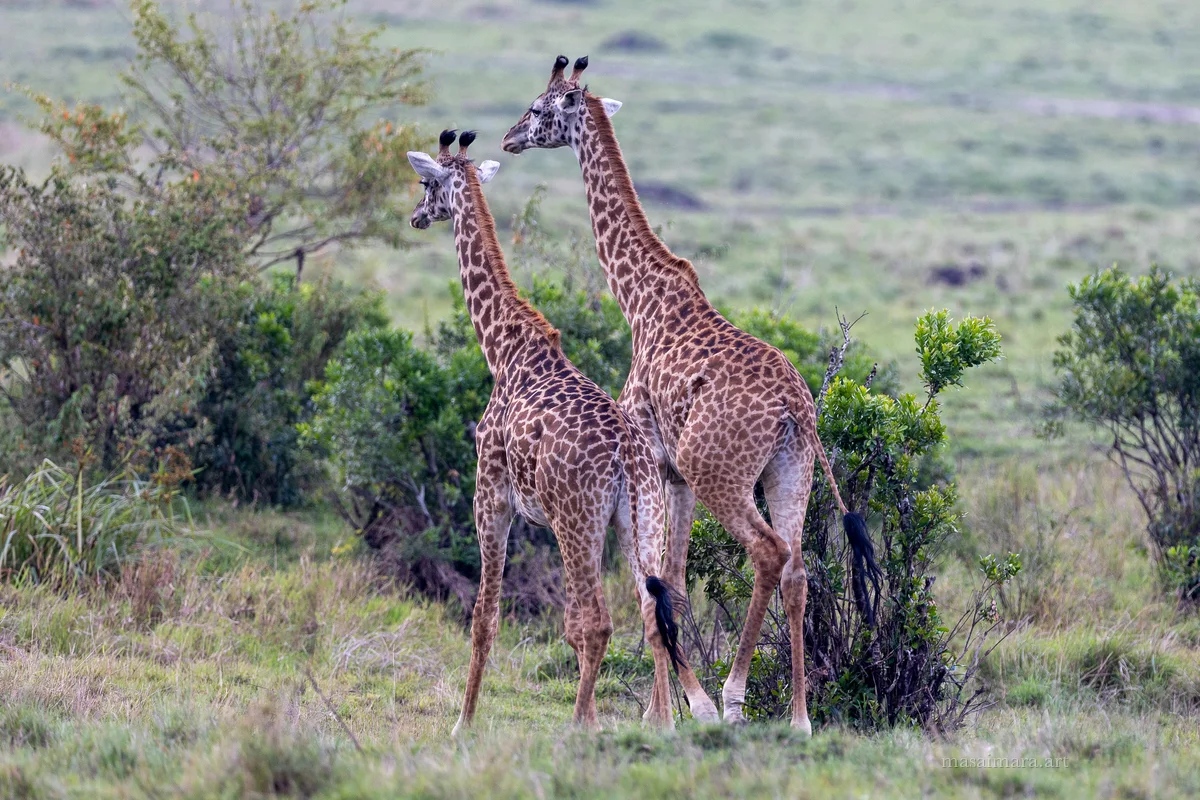
What two of them look at
When two giraffes are in the same frame with their heads up, they are almost always looking at the same thing. Most often it is a predator the lens has not yet found — a lion in the long grass, a cheetah on a mound, a cluster of vehicles where a leopard has been reported. The giraffe's eye is large, lateral, and high enough above the plain to read three hundred metres of grass the rest of the bush cannot. The herd's combined vision is, in the strictest sense, the savannah's earliest warning system.
The wildebeest watches the giraffe; the zebra watches the giraffe; the gazelle watches the giraffe. If the necks are turned, the plain knows. If the necks turn together, the plain runs.
“The neck is the picture. The plain is what the neck has measured.
”
Field notes
The light she takes
The giraffe is more photographable in the late afternoon than in any other hour of the day. The bush below is in shadow; the long neck and head are still in light. The cream of the pale coat reads warm; the patches go to a deep umber that the midday hour flattens to brown. The blue hills behind, in the same hour, soften into pale lavender. Every element of the picture moves toward each other; the giraffe is the line that holds them.
The window is narrow — perhaps forty minutes either side of the soft hour — and the giraffe knows it. By full dusk she has drifted into the cover of a thicket and is the bush again. By morning she is back at the bush but the light is wrong, the pale coat reading flat against pale sky. The afternoon is the giraffe's hour. The rest of the day is the rest of the day.
Giraffes
Giraffes
Giraffes
Giraffes
Giraffes
The giraffe leaves the picture the same way she enters it — vertical across the skyline, the plain measured. The morning that gives her does not announce her arrival; the morning that takes her does not announce her leaving.
The giraffe is the picture only by virtue of the plain that holds her — bush, open, horizon, three distances and the same body. The neck is the picture. The plain is what the neck has measured.
- Camera
- Canon EOS R5 Mark II · EOS R6
- Lens
- Sigma 500mm f/4 · Canon RF 70–200mm f/2.8