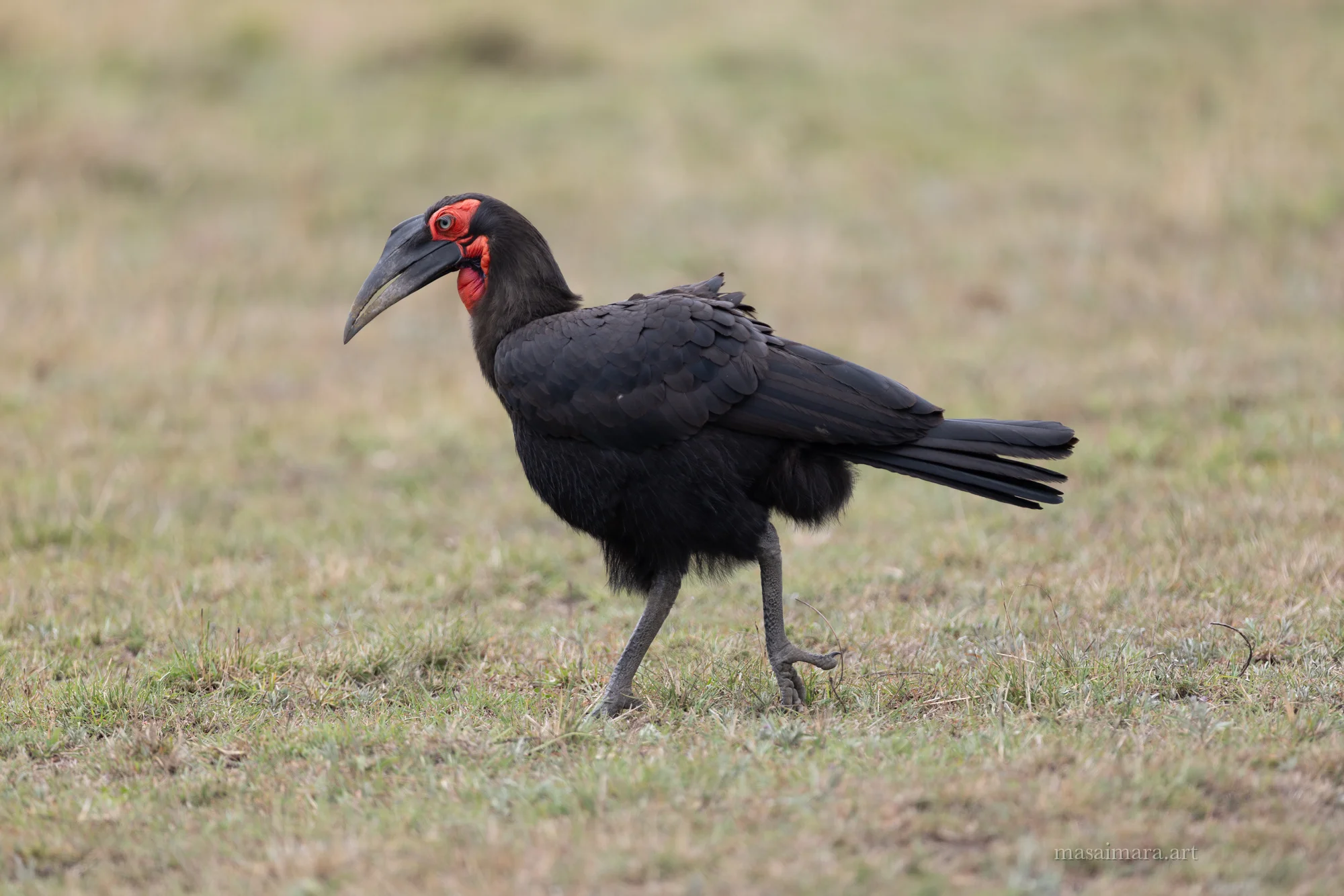
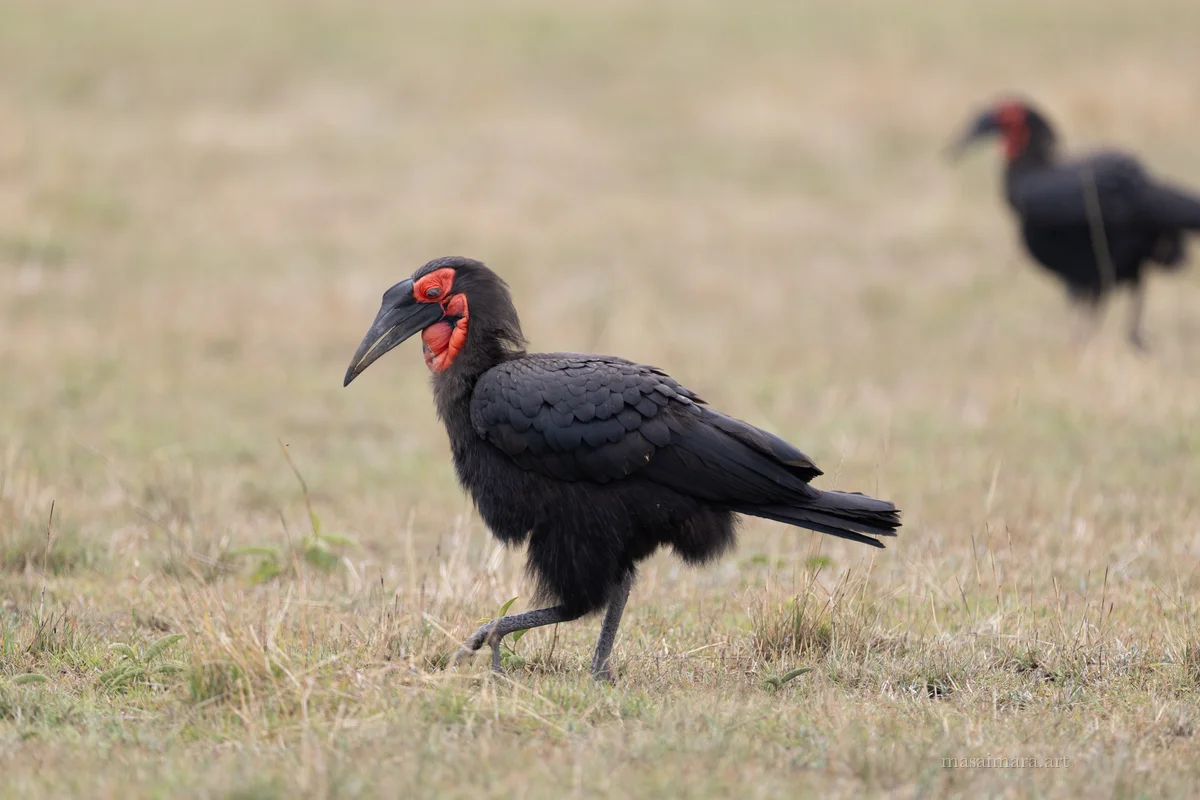
You forget how big they are until you stand near one. The southern ground hornbill is the largest hornbill on earth — a metre tall, four kilograms of mostly black feather and bare red skin and a heavy down-curved beak — and the frame admits all three at once on a strip of dry grass that contains, otherwise, nothing. The bird is the plain's most-stately walker. Lions sprint. Cheetahs sprint. Elephants stride. The ground hornbill walks, in the way a heavy old book is opened: slowly, deliberately, putting one foot down only when it has decided what the other will do.
The species belongs to a family — Bucorvidae — that the rest of evolution has, for the most part, abandoned. The closest living relative is the northern ground hornbill, separated from this lineage roughly twelve million years ago. Everything else on the savannah is, in evolutionary time, of more recent design.
The plain's stately walker
A ground hornbill covers between five and eleven kilometres of ground in a working day, almost always on foot. The bird can fly — the wings are heavy, slow, and visible against the savannah sky for an audible distance — but flies only when crossing terrain it would not walk, or when displaced from a foraging territory. The walking pace is roughly two kilometres an hour. The pace is the species.
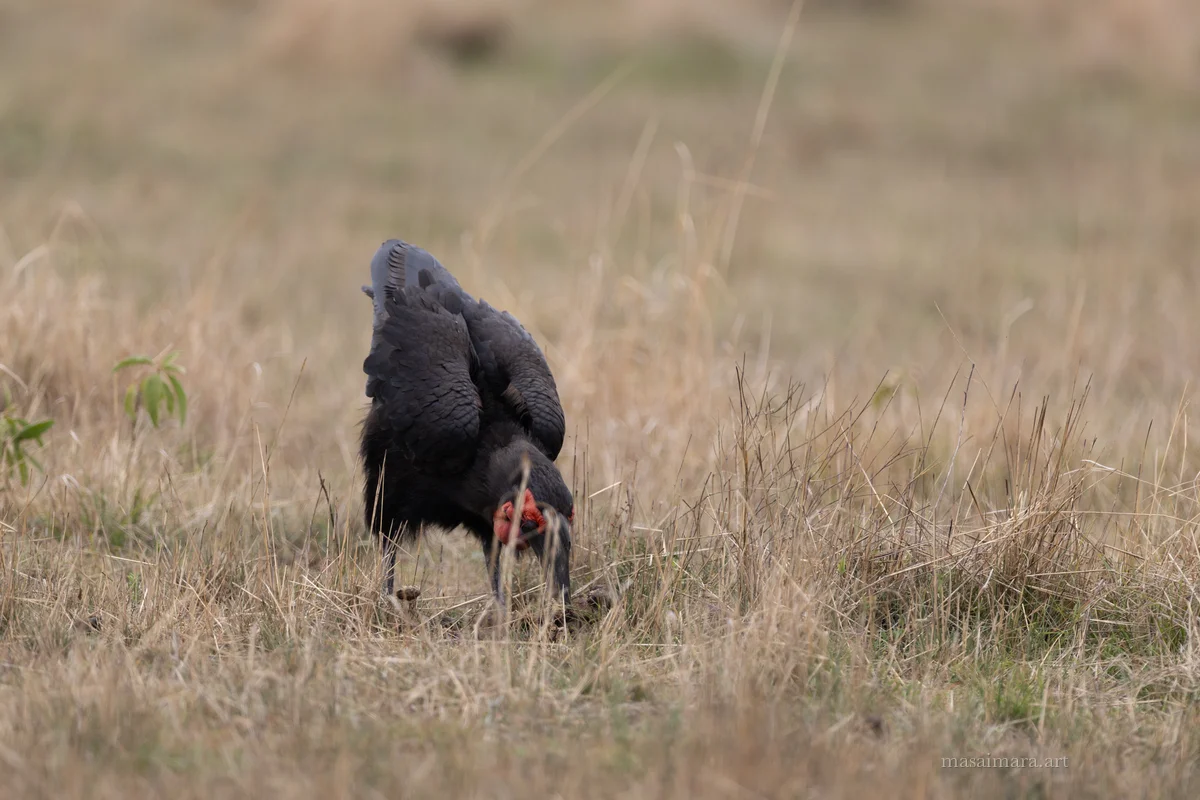
What the bird is doing, slowly, is reading the ground for movement. Insects, small reptiles, frogs, snails, occasionally young birds and small mammals — whatever the day's grass has produced. The down-curved beak is built for both fine work (a single termite) and heavy work (a snake the bird has decided to kill). The diet is opportunistic; the working method is not.
The group, and the long apprenticeship
A ground hornbill family holds between two and nine individuals — almost always a breeding pair and several non-breeding helpers, who are usually the pair's offspring from previous years. The young birds do not breed until they are six to seven years old; in the meantime they participate in the family's territory defence, foraging, and most importantly, the raising of the next chick.
A pair produces, on average, one chick every five to nine years. The number is not a typo. The species has one of the slowest reproductive rates of any bird on earth — slower than most albatrosses, slower than the largest condors — and the long, multi-year apprenticeship of the helpers is the family's strategy for closing the gap. A chick raised by the pair plus three or four older siblings is dramatically more likely to fledge than a chick raised by the pair alone.
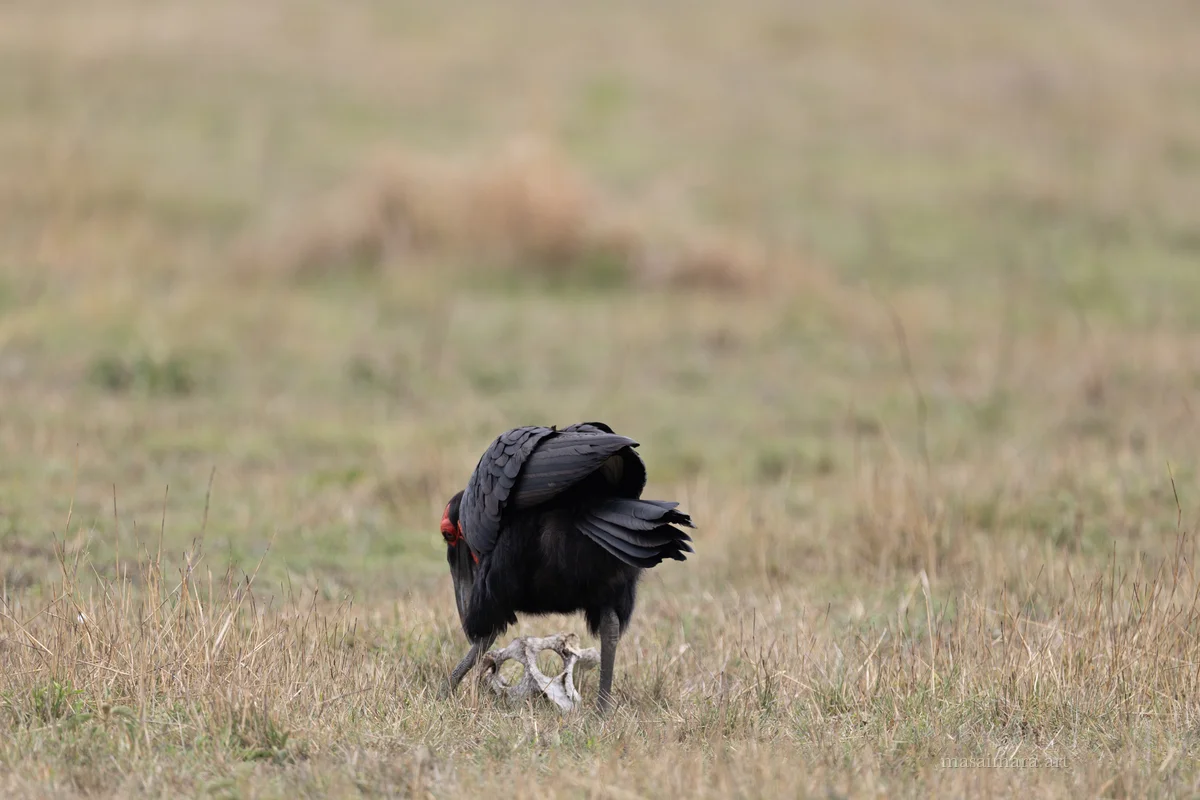
The plain's most-stately walker — photographed at the pace it sets, not the pace the camera prefers.
The boom
The ground hornbill's territorial call is the deepest vocalisation made by any African bird — a four-note boom in the low frequencies, audible at three kilometres across still air. The call carries because it is low, and the low carries because the species defends a territory that is, by the standards of most birds, enormous: a hundred to two hundred square kilometres for a single family group. The boom is, in practical terms, the only way to declare a perimeter that big.
The duet between the breeding pair is one of the few field signals reliably preceding a sighting. A bird answering another bird, two minutes apart, in the long grass behind a thicket, is a bird that within the next minute will walk into the open ground beyond the thicket. The picture is built on the call you heard ninety seconds ago.
Field note — On standing still
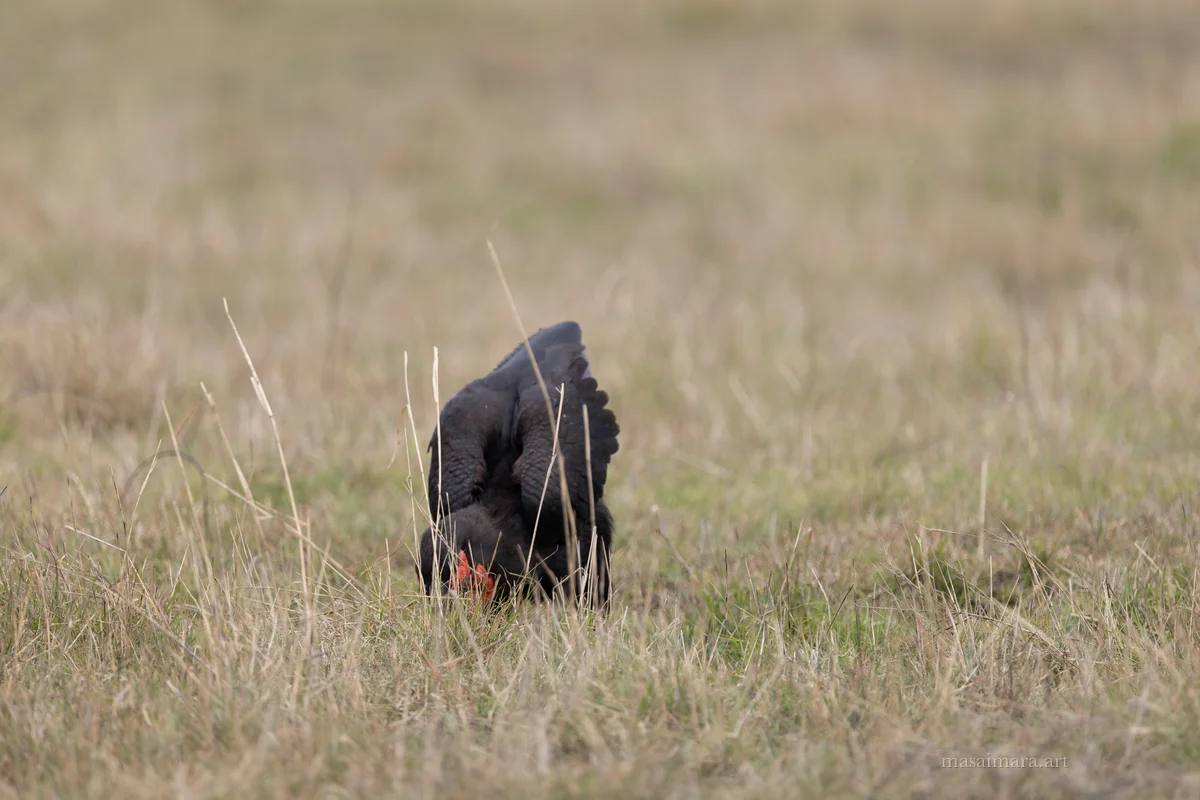
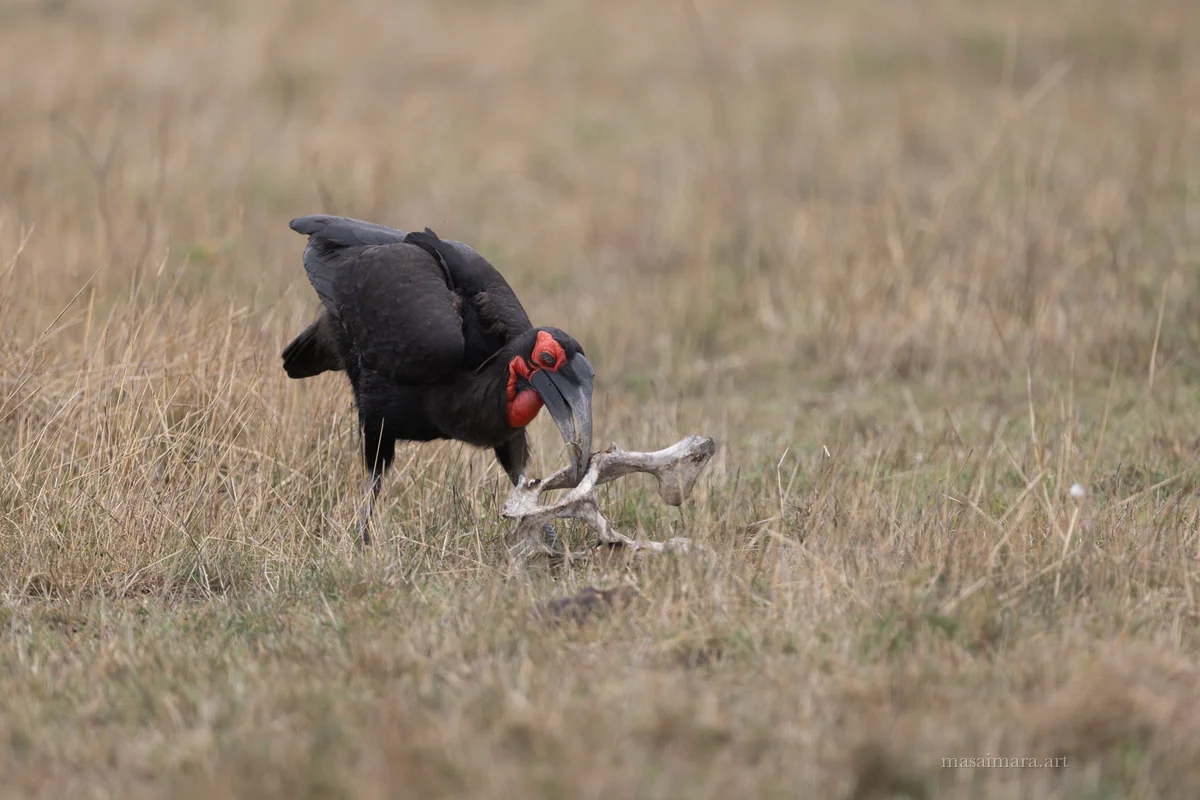
A pair of ground hornbills working a patch of pale plain will not acknowledge a vehicle that has stopped a hundred metres away with the engine off. The lens works in increments. Head down to the grass. The back arched. The beak closing around a slim piece of wood. The head lifting. The bird beginning to walk again, the wood still held. The lens does not ask what the wood is for — only that the bird has considered it worth carrying.
The morning does not offer action. It offers the slow walking of two large birds across pale grass, the red of the bare throat against the black of the plumage, and the deliberate way ground hornbills always move. The afternoon, returned to, holds them in the same patch of grass, still walking, slowly, in a direction the morning has not yet finished defining.
What the beak holds
The most photographable behaviour of the ground hornbill is, paradoxically, also the most domestic. A bird carries food, nesting material, or small offerings to the chick in the beak — a stick, a beetle, a chameleon, a small snake — and the carry is held high enough above the grass to be visible at distance. The bird walks with the cargo for as long as the next destination requires; the cargo is dropped only at the nest or at the chick.
A pair carrying material to the nest is, in field terms, a confirmed breeding pair. The ground hornbill nests in a large tree cavity — most often a baobab or a large fig, sometimes a hollowed-out fever tree — and the nest is occupied for one hundred and twenty days from laying to fledging. The chick emerges in the long rains, when the food is at its highest abundance.
The eyelash
The southern ground hornbill has long, pale, almost theatrical eyelashes — modified feathers, technically — that shade the eye from the African sun and protect it from the small insects the species disturbs while feeding. They are, on a bird whose face is otherwise dominated by red bare skin and a heavy beak, the only delicate element of the design. The strongest portraits catch them in profile, at the moment the head is turned and the eye is briefly the brightest thing in the frame.
The female is told from the male by a small patch of violet-blue skin on the throat, set against the otherwise uniform red. From a hundred metres the field mark is invisible. From thirty metres, with the head turned to the lens, it is the difference between two photographs.
“The step is the photograph. The head is the punctuation.
”
Field notes
The ground hornbill is the slowest deliberate thing the Mara has, and she walks at the pace she sets. The morning that holds the camera at her speed returns with the picture; the morning that does not, returns with grass.
Two large birds walking pale grass — colour against the dark plumage, the deliberate slow pace. Ground hornbills are the slowest deliberate thing in the Mara.
- Camera
- Canon EOS R5 Mark II
- Lens
- Sigma 500mm f/4