The elephant is the Mara's quietest large animal. The lion announces, the buffalo bulls graze in plain sight, the hyena vocalises across miles of plain — the elephant moves through twenty thousand kilograms of grass without making the grass move audibly. A herd of fifteen animals can be a hundred metres away in moderate cover and unread by the vehicle until the matriarch turns her head.
It is also the largest land animal on earth, and in straight-line terms the most photographable. The body is a single legible shape from a long distance; the colour reads cleanly against any background the Mara has; the speed is contemplative. What it is not, is a presence the rest of the savannah ignores. The elephant moves and the grass parts and every other species adjusts.
The herd is the matriarch
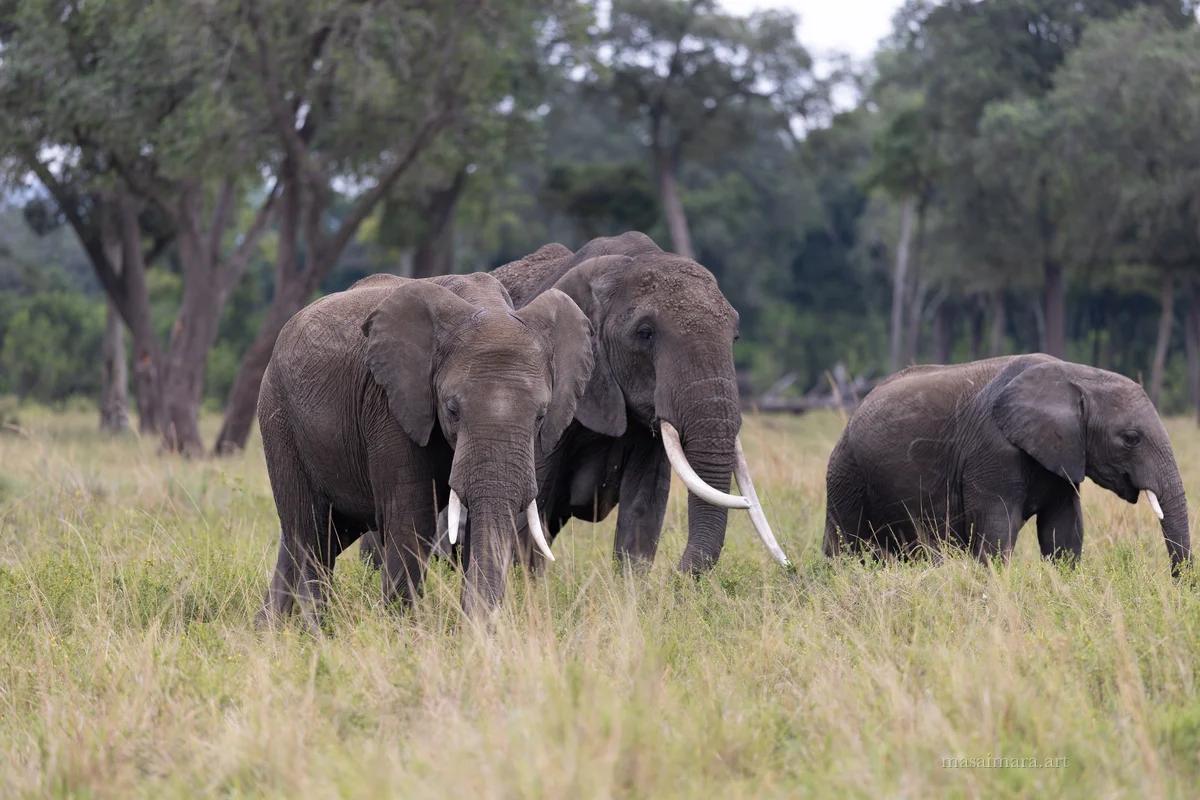
The Mara herd is a matriline. The oldest female — usually the largest — holds the family, and the rest of the group is her daughters, her granddaughters, and their calves. Bulls leave at twelve or fourteen years old and live the rest of their lives alone or in loose male groupings, returning to the herds only to mate.
The matriarch is the herd's memory. She knows which waterholes hold water in the dry years and which fail; she knows which corridors the Maasai families use for cattle and which do not; she knows the route to the salt licks north of the Reserve from a tree she has not visited in eight years. The herd that loses its matriarch loses the map.
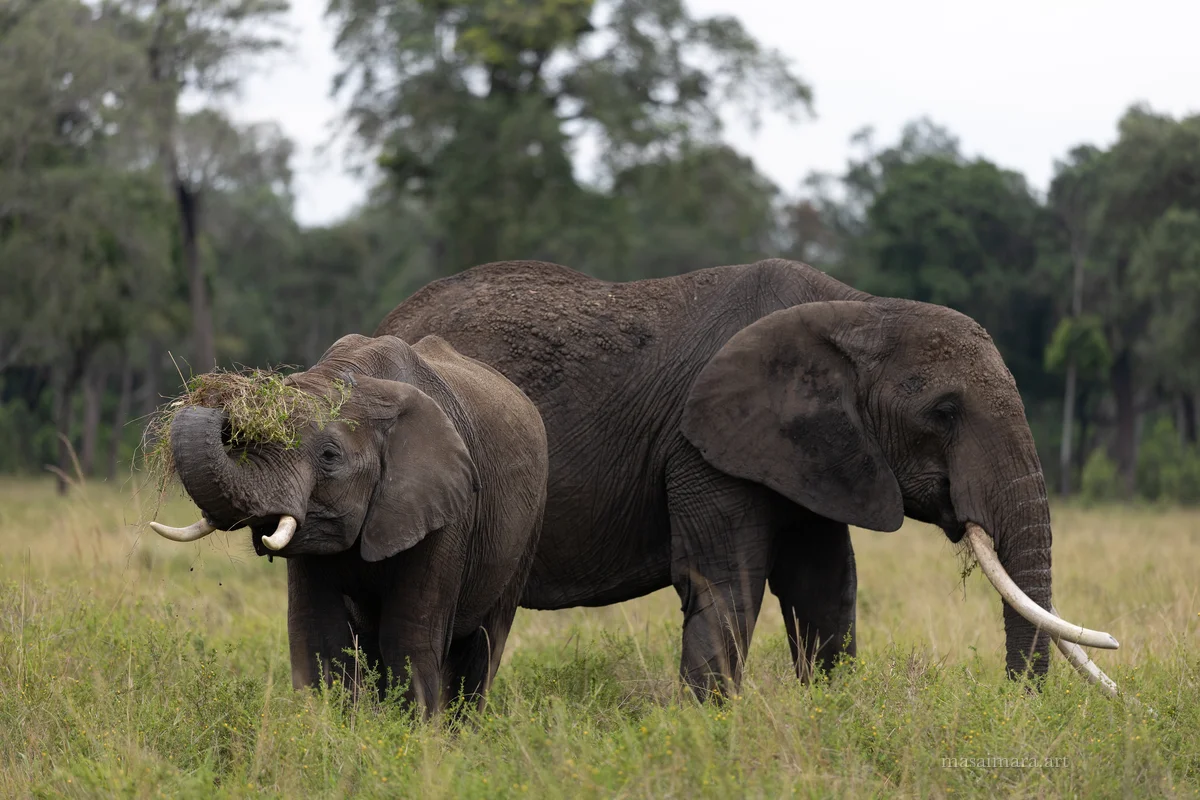
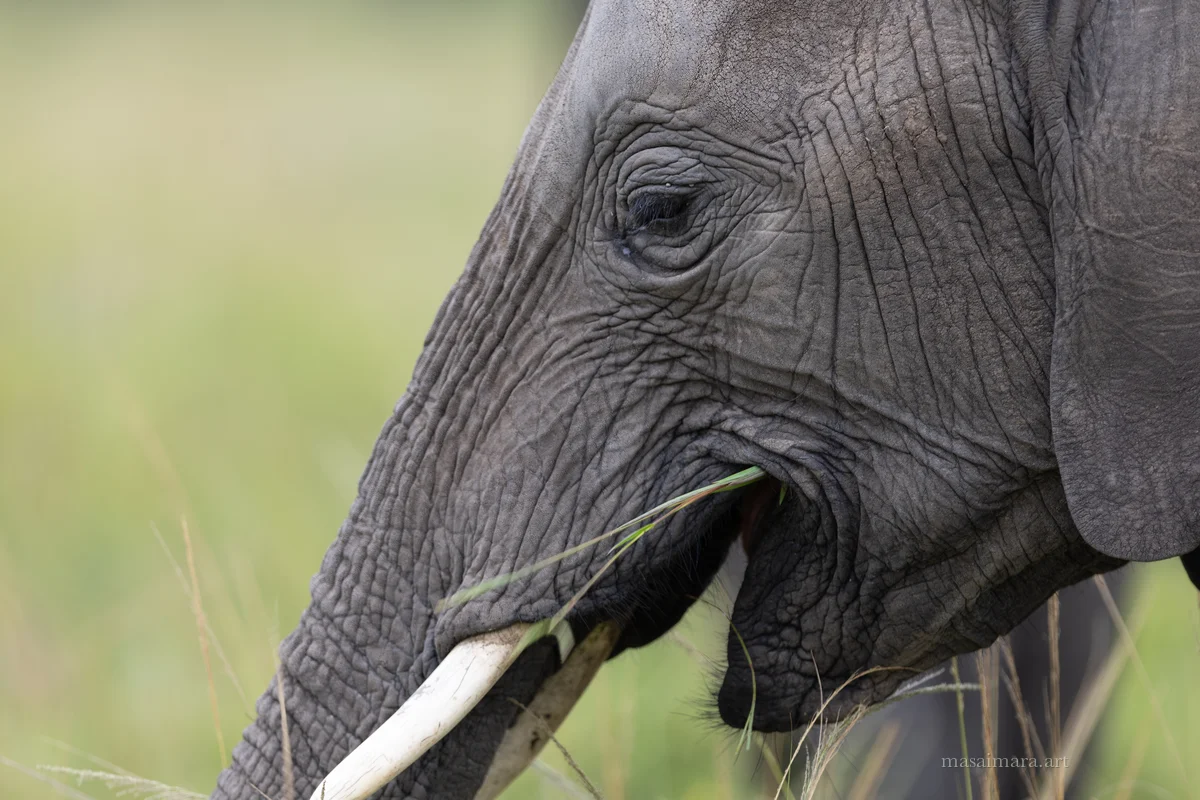
The trunk
The trunk is the most articulate piece of mammal anatomy on earth. Forty thousand muscles, no bones, capable of pulling up a stalk of grass and stripping a thirty-metre branch with equal precision. The tip ends in two finger-like processes that can pick up a single leaf or hold a thirty-kilogram log against the body.
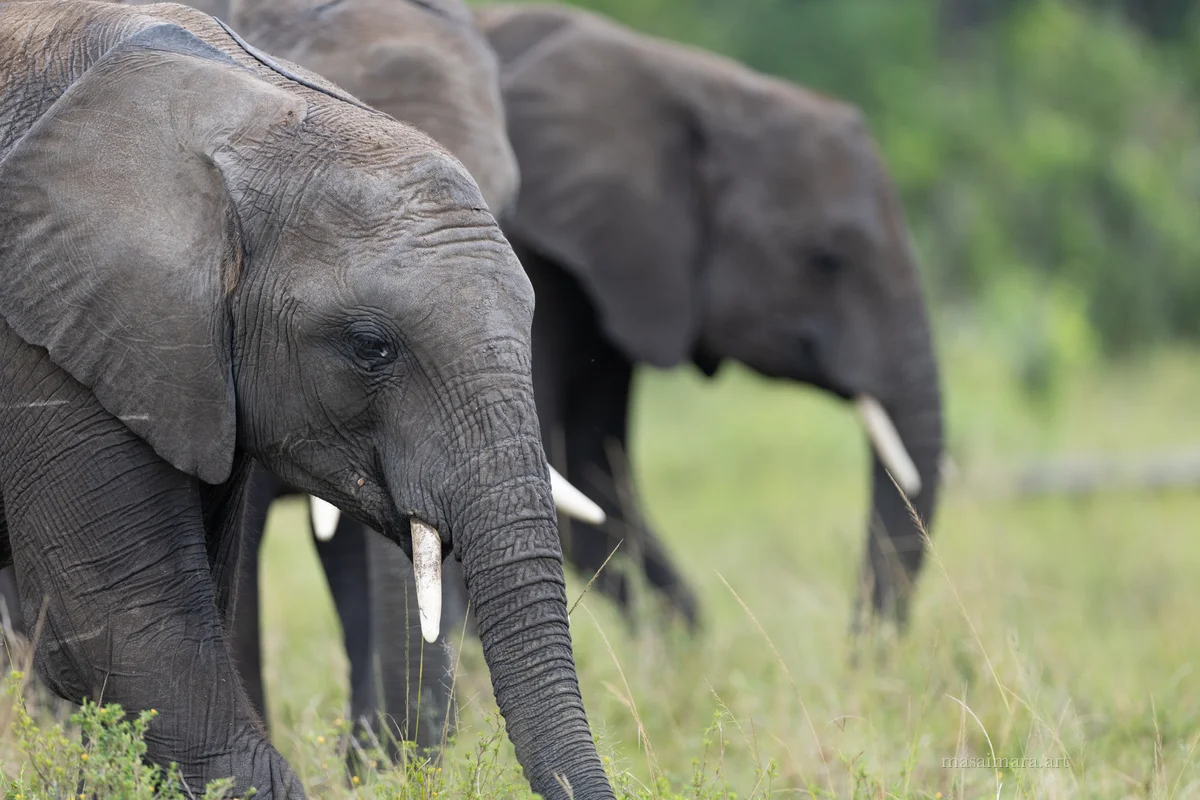
What the camera sees most often is the trunk in mid-curl — a wad of green stalks being lifted to the mouth, the bend of it absorbing the weight, the eye crinkled soft above. The trunk is the elephant's face, in practice; the eye is mostly closed, the ears are mostly listening, and the trunk is doing the work that in a human would be done by hands.
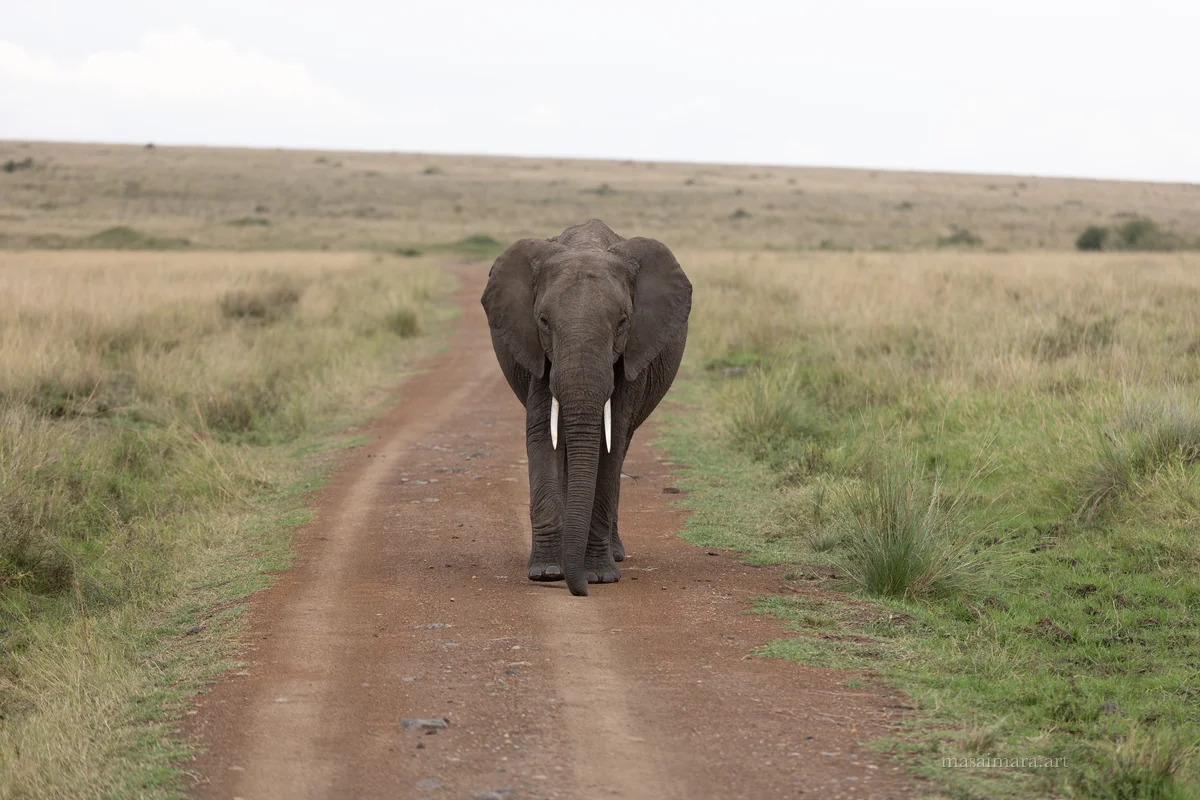
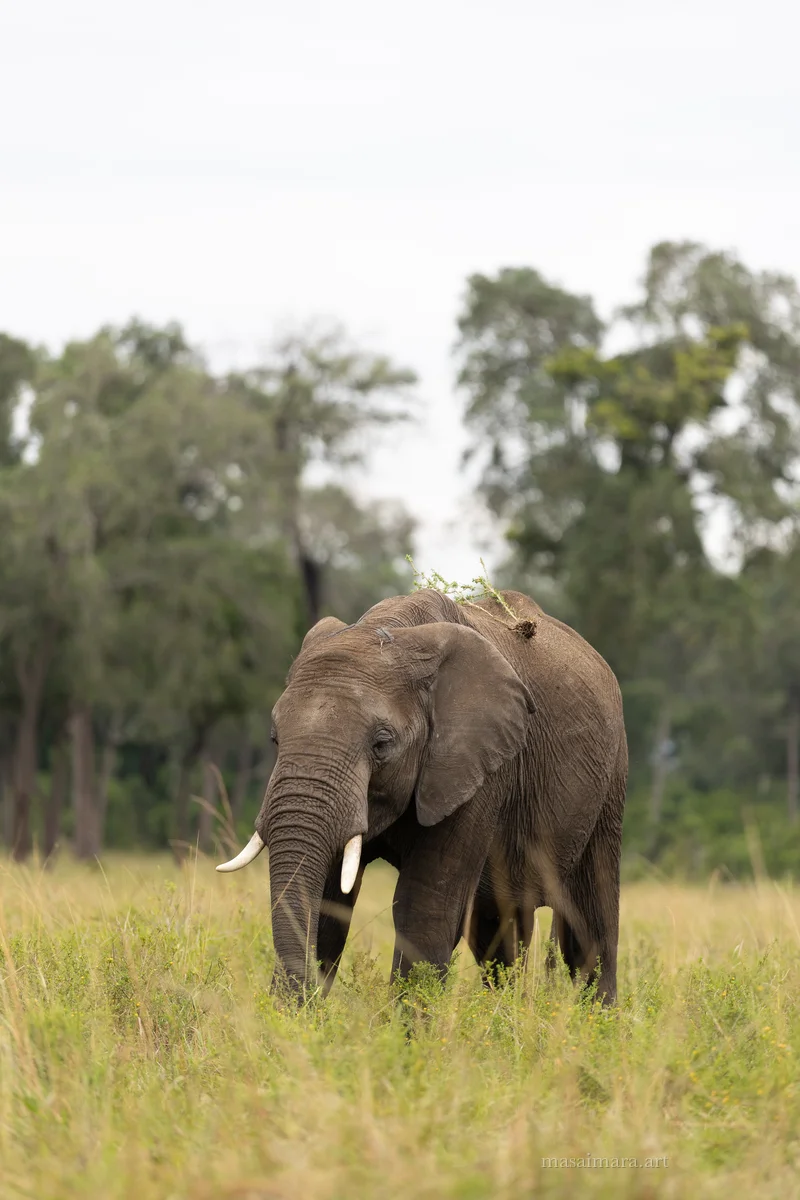
A single bull alone on the long red track, the pale plain on both sides — the day's largest animal; the day's quietest event.
The wet season elephant
The Mara is a marginal range for the African elephant. The plains are too open and the dry months too dry for the kind of woodland-and-water mosaic the species evolved to use. The herds drift onto the Mara plains during and after the rains — March to May for the long rains, November and December for the short — when the grass has come back.
The migration season — the months the rest of the Mara is densest with mammals — is, for the elephant, a thinner season. The bulls remain. The breeding herds withdraw. A reliable elephant morning is more often a wet-season morning than a dust-season morning, and the photographer who has only ever come for the wildebeest crossings has, in most cases, photographed an emptier Mara than she thinks.
Field note — Two rooms
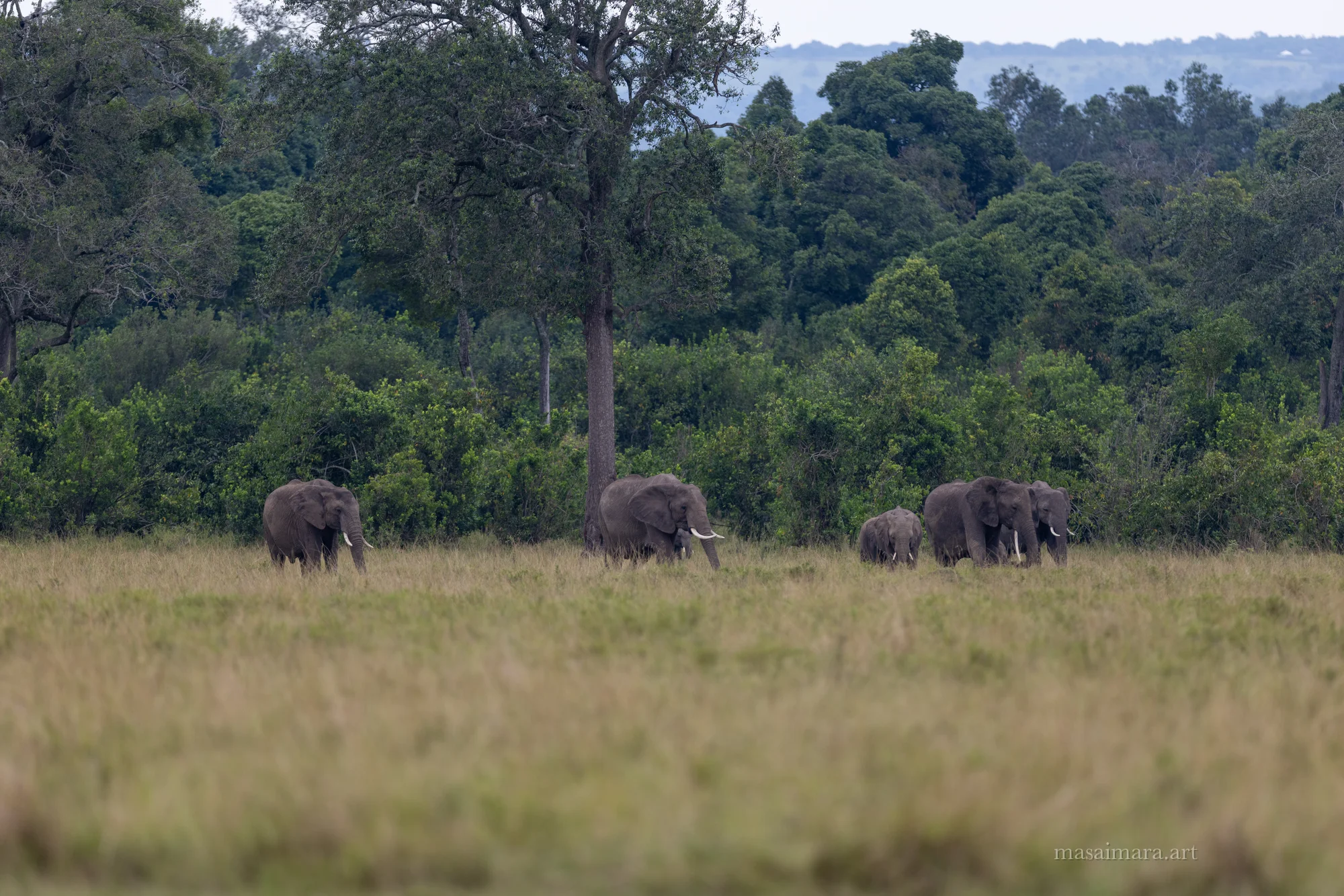
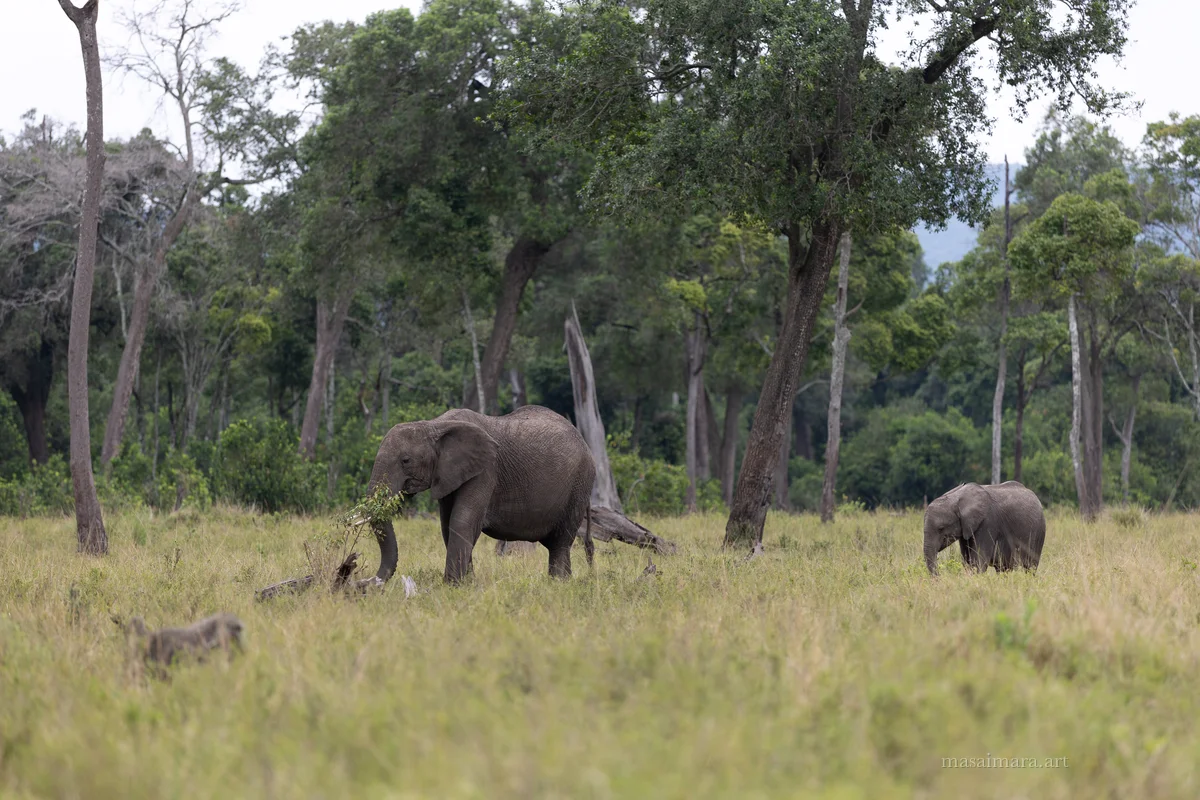
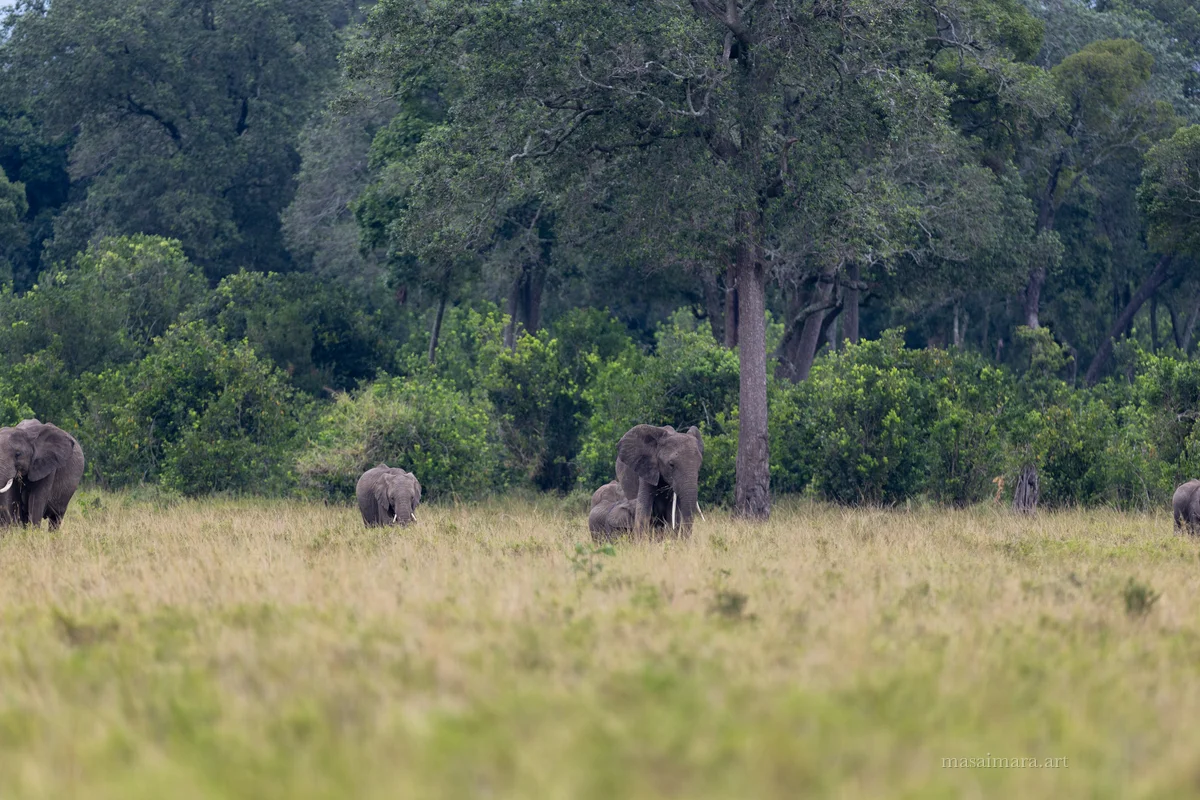
The elephant occupies two distinct rooms of the Mara, often within the same morning. The family at the edge of a wood — adults at either end of the line, a calf in the middle, the seam between green canopy and pale grass the room they are using. A single bull on a long red murram track between empty green walls, head-on, ears half-spread, no other animal in any direction.
Same species. Two entirely different rooms of the camera. The forest gives the family a screen; the road gives the bull a stage. Neither room is the wrong room. The day's largest animal will occupy whichever the morning offers him.
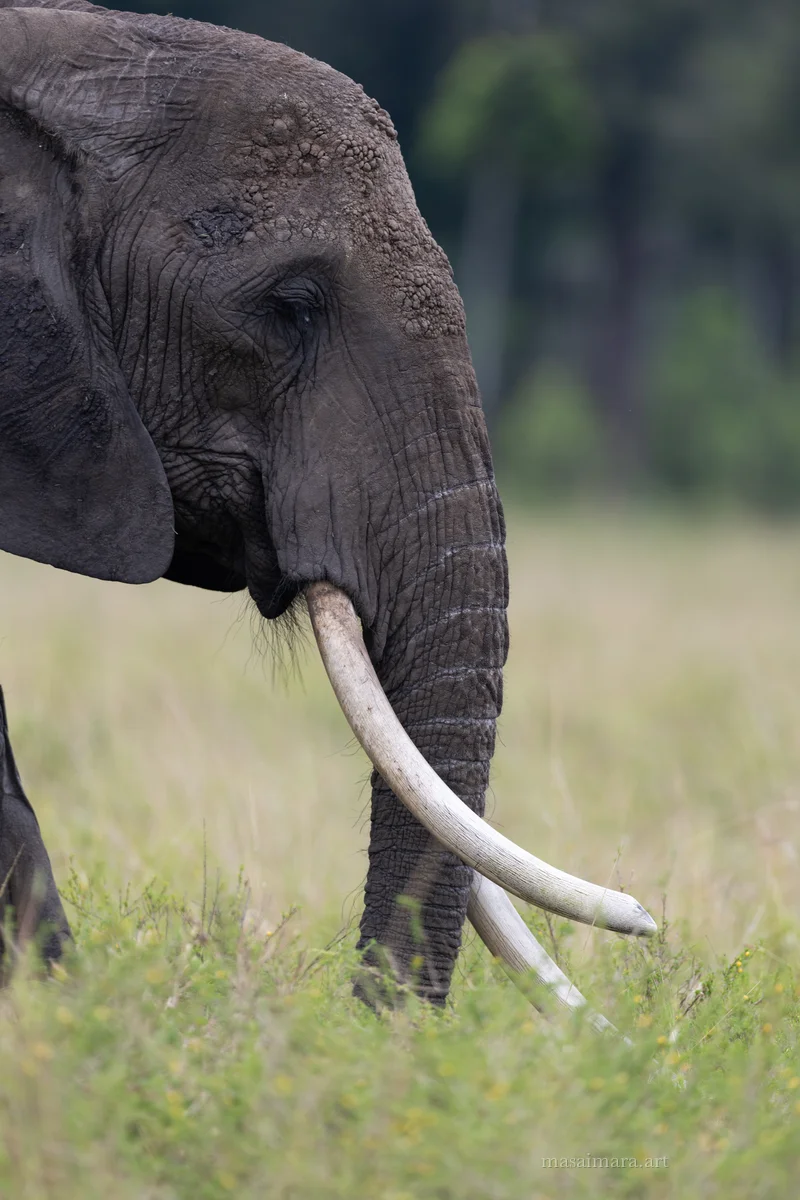
The tusks
A Mara elephant's tusks are smaller than the ivory-carved monuments of the older photographs. Decades of poaching pressure across the broader range have produced a heavy genetic skew toward smaller-tusked or tuskless individuals; the largest-tusked bulls of the 1970s and 1980s did not, on the whole, leave descendants. The bulls visible on the Mara today carry tusks that are workmanlike — used for digging, stripping bark, occasionally for sparring with rivals — and rarely the long graceful curves of the museum photograph.
A tuskless elephant is a less valuable target, and the gene is, in the worst-hit populations, propagating. The species has been altered, quietly, by the long century of being shot for the curve at the front of its face.
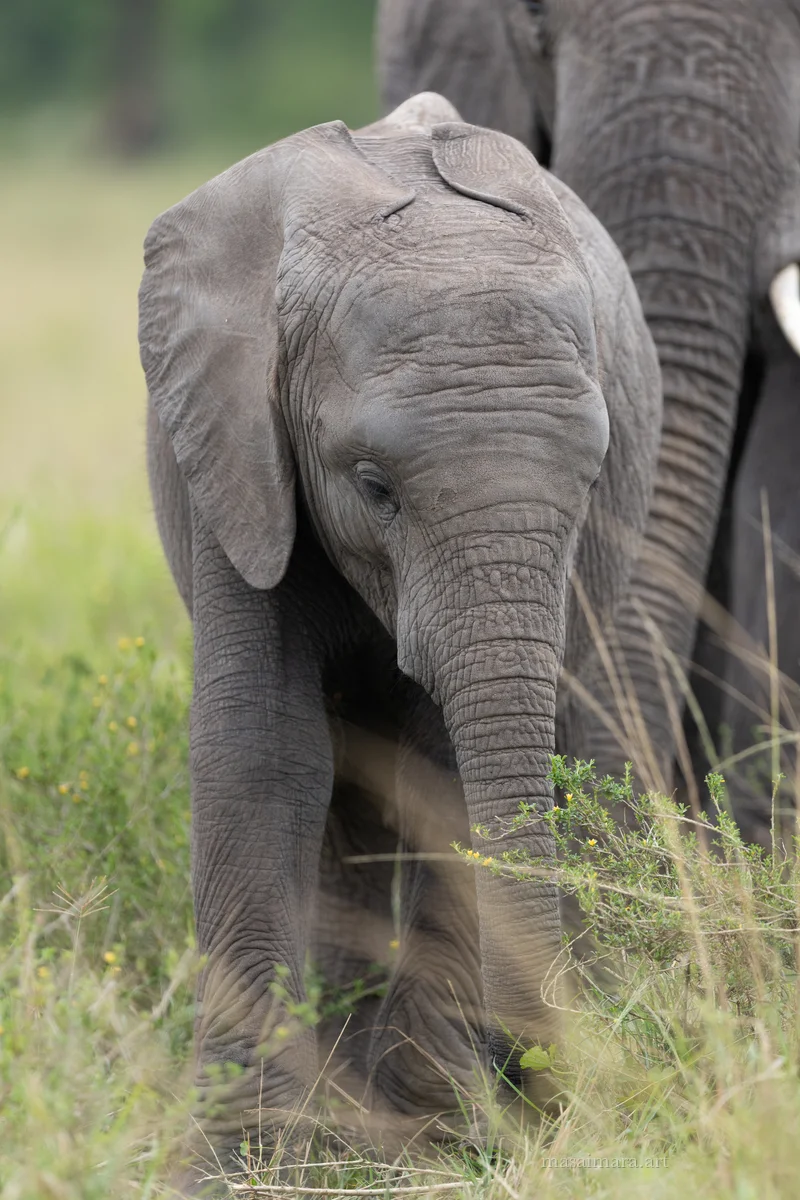
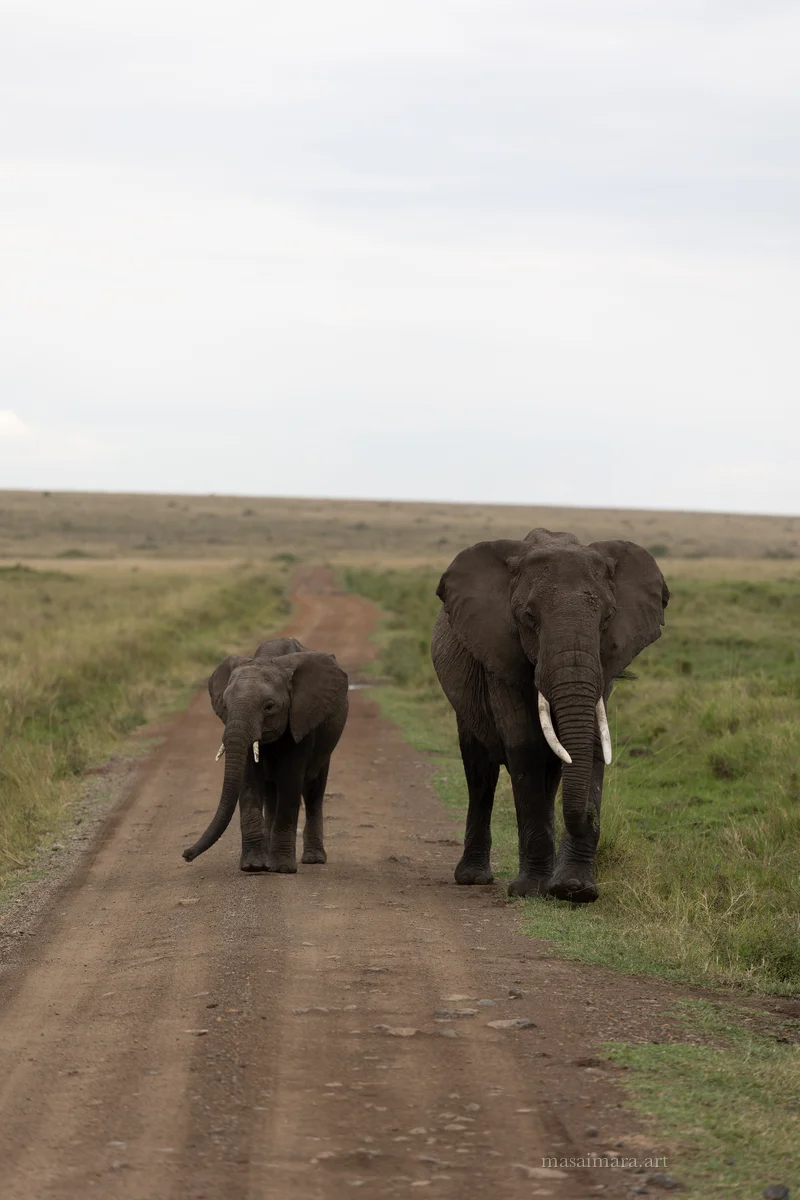
Two calves, two rooms — the young one in the forest light beneath the matriarch's bulk, and a mother and her calf walking head-on down the long red track.
The calf
A calf at birth weighs roughly one hundred kilograms and stands within thirty minutes. For the first six months it is rarely more than two metres from its mother. By a year it can travel with the herd at the herd's pace; by three years it has begun to use the trunk with some skill; by five it is solid food only. The herd raises every calf collectively — the aunts, the older sisters, the matriarch — and a calf orphaned at three years is, in most cases, adopted without ceremony by another lactating female.
The calf you photograph closest to the herd is, in nearly every case, less than five years old. Past that age the calf takes a wider berth and the camera does too.
The bull on the road
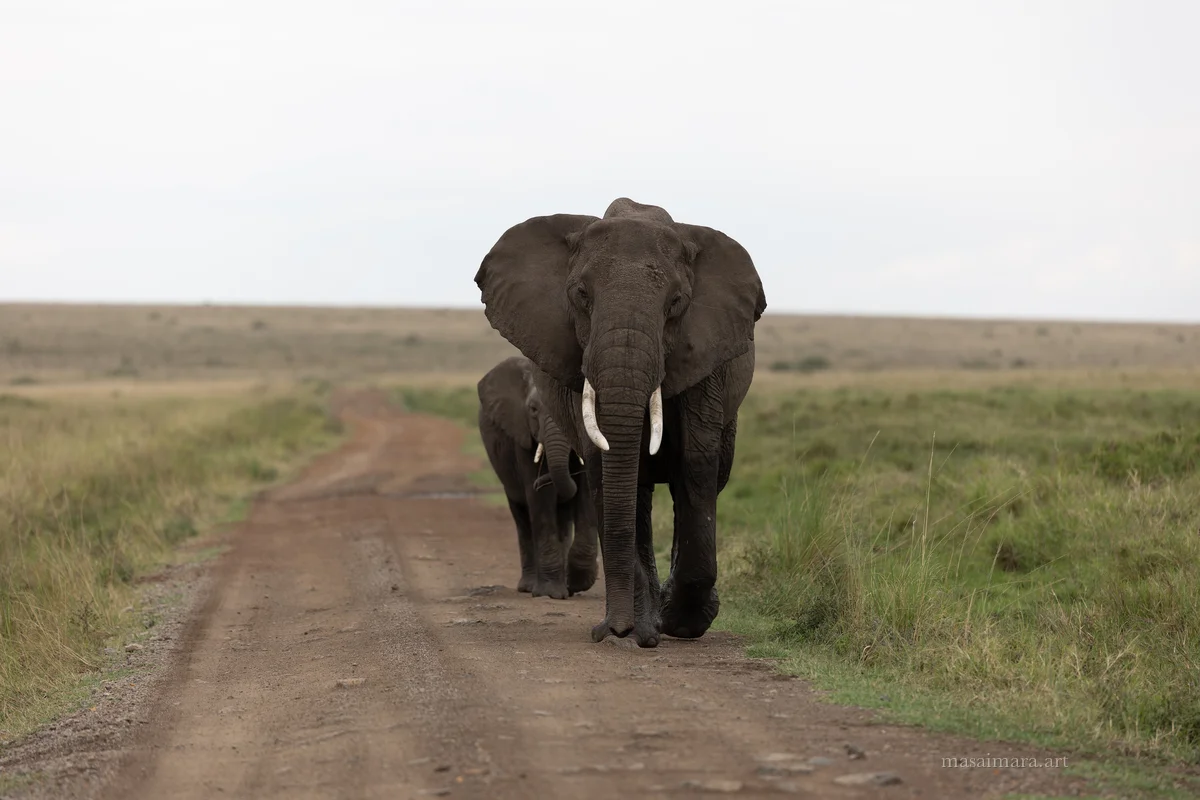
The road, for the elephant, is a corridor — not the imposition that it is for the lion or the lure that it is for the cheetah. The Mara's red murram tracks were cut along old game routes, and the elephant remembers them as game routes. A single bull walking head-on down the track is not unusual; the picture in which the road is his and the vehicle is the polite intrusion is the picture the elephant has been making since well before the first vehicle arrived.
The geometry composes itself. A band of dust through deep green; the bull centered, ears half-spread, trunk loose; the pale plain on both sides past the green walls. The road is briefly his room, and the camera has been given the angle without asking for it.
“The road is briefly his room. The vehicle is the polite intrusion.
”
Field notes
The road as room
The track is wide enough to admit two elephants only in series, not abreast. A family on a road is a column; a pair on a road is a procession. The picture finds the elephants the way the road finds them — one head behind another, the second visible only as a half-shape at the hip of the first, the depth of the lane doing the geometry the open plain never quite manages.
What this means for the camera is that the strongest elephant pictures in the Mara are taken in the direction of travel, head-on, and that the vehicle that has stopped a hundred metres before the herd arrives gets the picture the vehicle that has driven up alongside does not.
The day, quietly
The elephant is the only animal in the Mara whose photographable day is, in the literal sense, more peaceful than the morning around it. The lion sleeps loudly; the leopard hides tensely; the cheetah waits restlessly. The elephant grazes. The herd moves at five kilometres an hour. The young feed. The matriarch keeps the line. Nothing in the picture is hurried, including the parts of the picture that are eating.
A good elephant morning is the slowest morning in the Mara. The lens does almost no work. The photograph composes itself from the patience the herd brings to it.
Elephants
Elephants
Elephants
Elephants
Elephants
The elephant ends the morning the way she began it — quietly. The grass that does not move audibly while she is moving through it is the grass that closes after she is gone. The picture is the silence she leaves the camera holding.
The elephant lives in two rooms — the family at the seam of green wood and pale grass, and the bull alone on a long red track. The same species fills both rooms quietly, and the camera measures the room more than it measures the animal.
- Camera
- Canon EOS R5 Mark II · EOS R6
- Lens
- Sigma 500mm f/4 · Canon RF 70–200mm f/2.8