Most of a cheetah day looks like nothing has happened. The cat sits upright in long grass, head still, ears forward, three hundred metres from a herd she has been watching for two hours. The plain around her does its slow work. The light moves. A vehicle that has been parked at the bottom of the rise for the same two hours has, in technical terms, been doing the photograph the whole time without taking a single frame of it.
This is the cheetah. The fastest land mammal on earth, in practice, is the most still cat in the Mara. The sprint, when it comes, is one frame long. The hour around it is the work.
The architecture of a watch
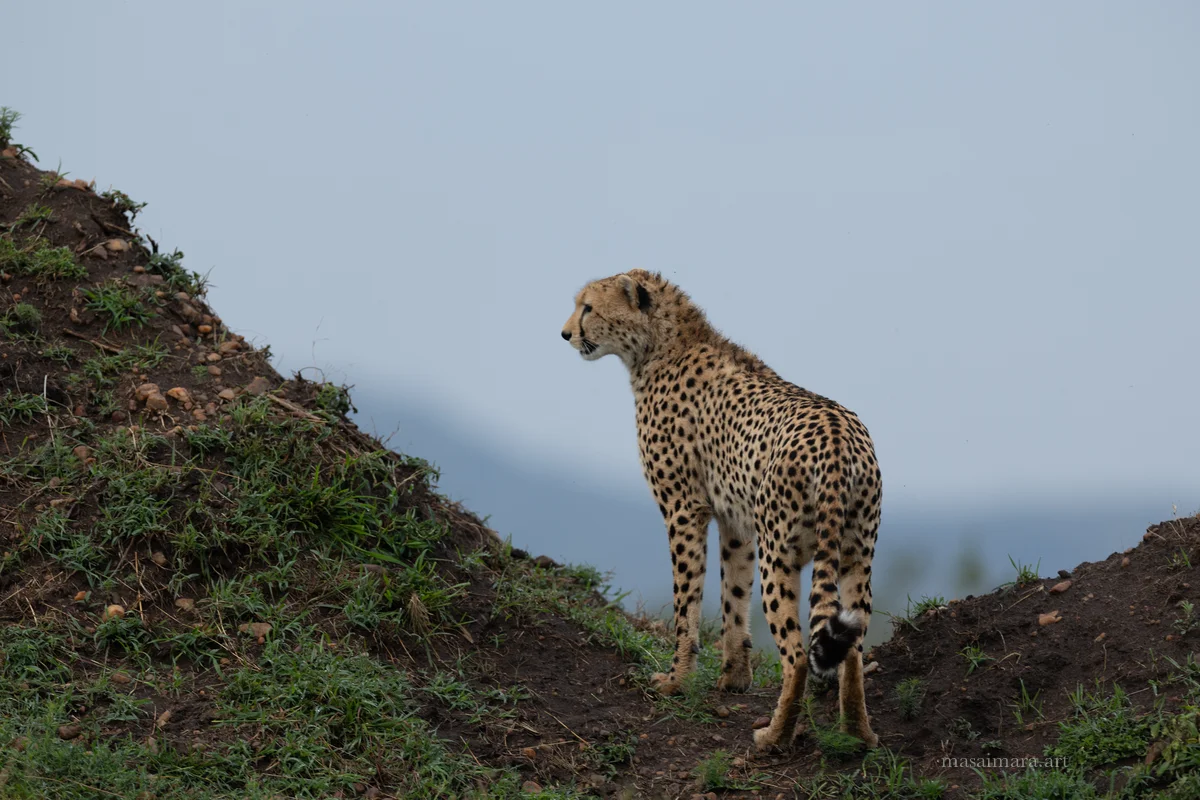
A cheetah hunts the way the Mara hunts itself — through elevation. A termite mound, a fallen log, an erosion ridge, the low shoulder of a granite outcrop. The eye is the weapon; the legs are only the closing argument. From a metre and a half above the plain a cheetah can read a herd of Thomson's gazelle at a kilometre and pick the calf that is one stride behind its mother.
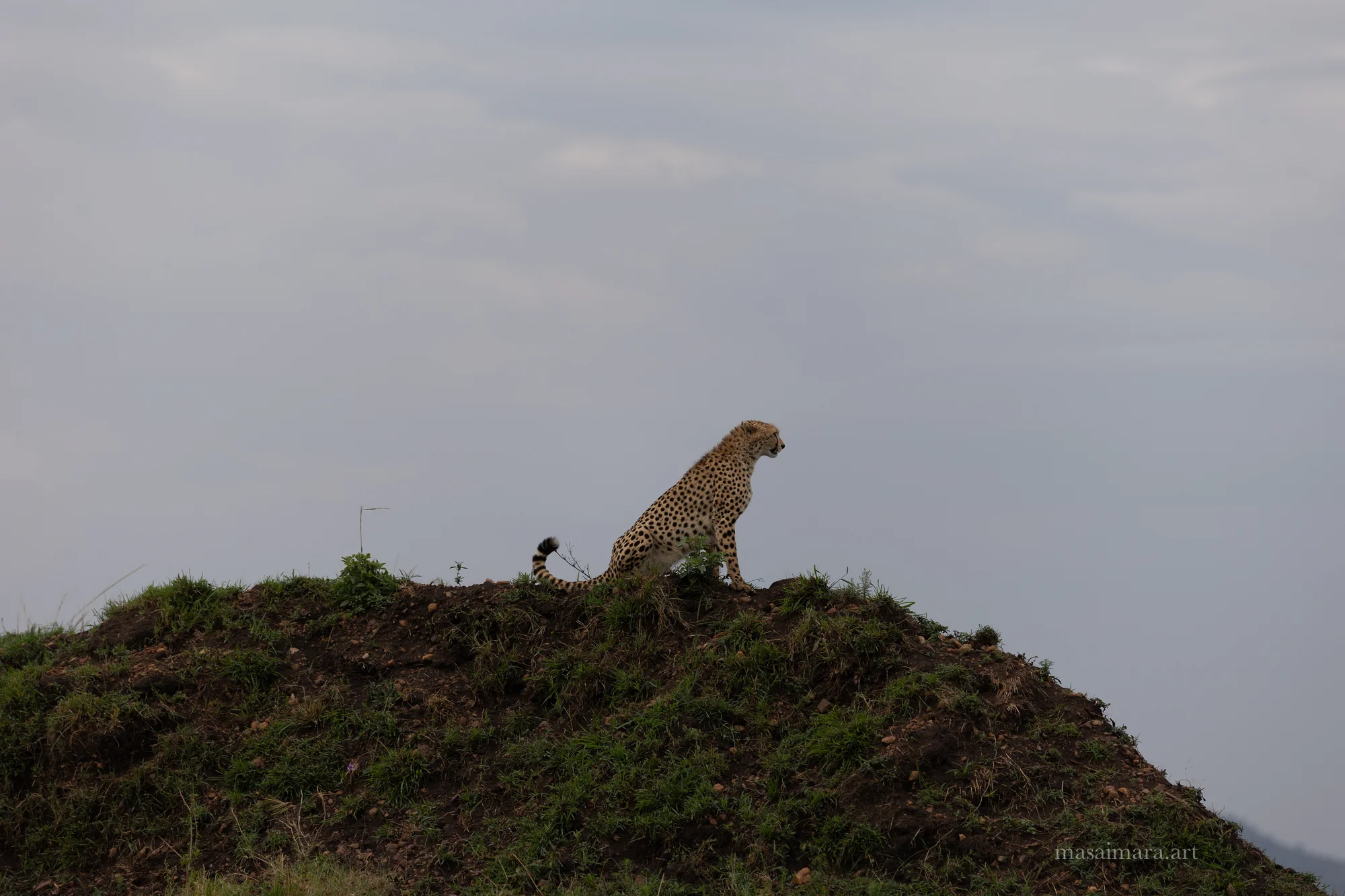
The architecture matters more than the cat. The picture begins the morning the wider lens finds the mound and waits for the cat to arrive on it. By the time the cheetah is in the frame, the photograph has already been composed.
The diurnal cat
The cheetah is the only one of the Mara's three big cats that is fully diurnal. The lion hunts mostly at night; the leopard hunts at the edges of light; the cheetah hunts in the open hours the other two have given up. The reason is the same in all three cases — competition. A cheetah cannot defend a kill against a lion, often cannot defend it against a leopard, and routinely loses it to a clan of hyena. The only thing she can do that the others cannot is be visible in heat.
The cost of diurnality is that the working windows are narrow. The first hour after sunrise and the last two hours before sunset. Between them she lies in whatever shade the morning has left her, panting through the heat with her body extended along the ground and her head almost touching the earth.
The hunt
The hunt is one of the briefest events in nature. From the first stride to the catch is rarely more than twelve seconds; the chase distance is rarely more than three hundred metres. The cheetah cannot maintain top speed past about thirty seconds without overheating to the point of collapse, and she knows it. The whole geometry of the hunt is therefore aimed at being one stride from contact when the prey turns.
What the camera catches, almost always, is not the run itself but its punctuation — the dust trailing low behind the back paws, the head down on the catch, the body briefly flat against the prey before the grip is set on the throat. Two seconds, half a roll of frames, the rest of the hour either side of it.
The stalk
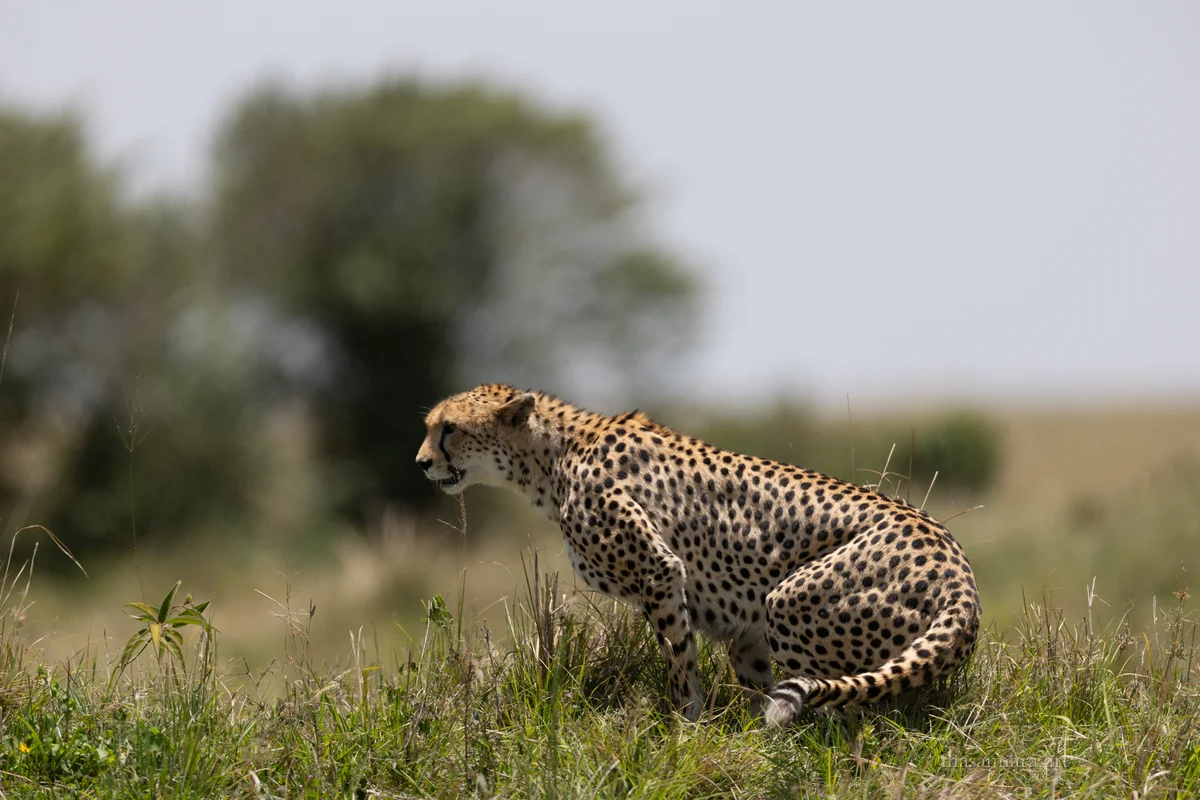
Before the sprint comes the stalk. The body drops low into the grass, the shoulders are the only part of the cat that reads above the cover, the head is forward, the ears flat. The posture is held for as long as the herd takes to give her the angle. Ten minutes is short. Forty is normal.
The cheetah's stalk is, in absolute terms, the worst stalk among the Mara's predators. She has no spotted concealment in tall grass the way the leopard does; no pride of cooperating animals the way the lion does. What she has is the read of distance and the willingness to be patient with it. The stalk closes the gap from two hundred metres to fifty. The fifty is the sprint.
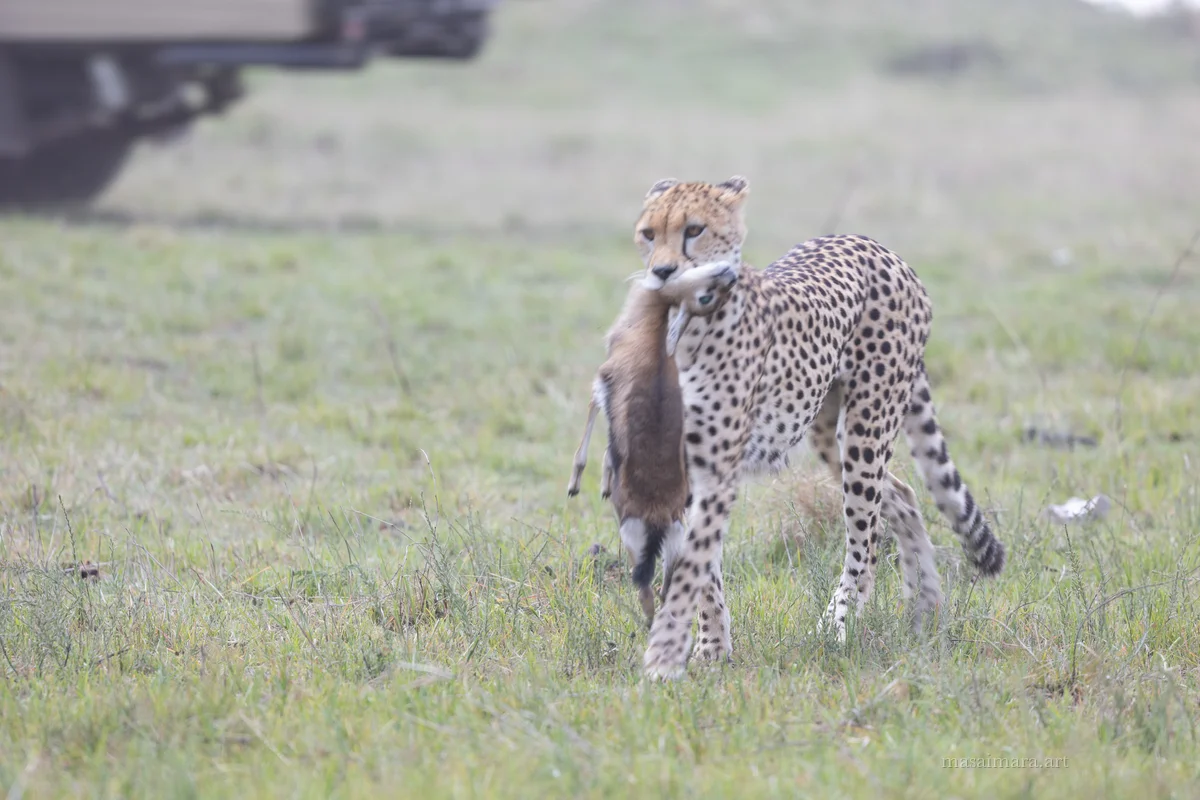
An hour after the catch, the carry — the body relaxed, the fawn soft in her jaws.
Territory
Adult male cheetahs hold territory. Adult females do not. A coalition of brothers — most often two, sometimes three, in rare cases four or five — defends a working range that overlaps the home ranges of several females and excludes other males from the same ground. The territory is held by scent and patrol rather than display. A coalition will walk thirty kilometres along the edges of what they own in a day, marking termite mounds and fallen logs with urine and with a clawed scratch in soft wood the females will read from a hundred metres away.
Females contest ground less often. Their home ranges overlap freely and avoidance is the rule — a cheetah at a kilometre will read another cheetah at a kilometre and adjust her line by half. The exceptions are around cubs and around a fresh kill, and in both cases the conflict is short.
The rare conflict
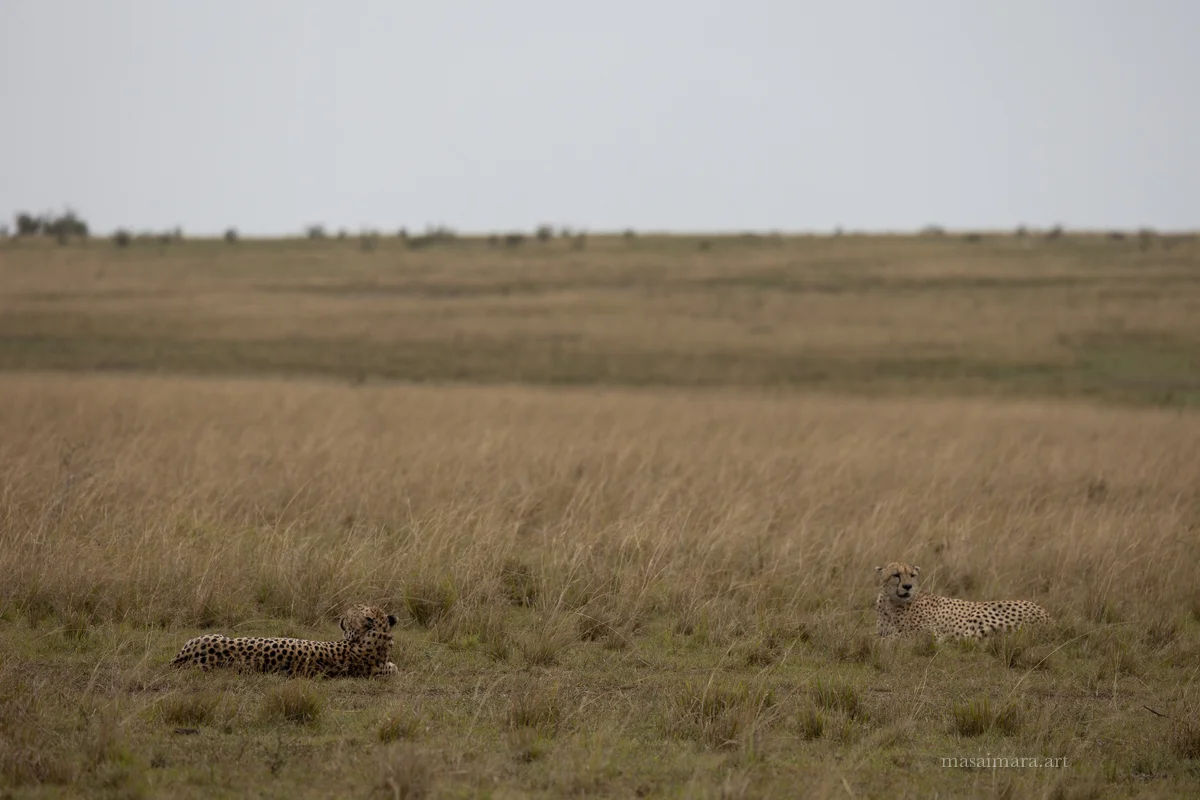
When the line is crossed, the resolution is brief. What looks from sixty metres like two cats standing still in pale stalks is, almost certainly, two cats deciding whether the next two seconds are going to happen. They usually do not. The cat that has misread the territory backs off, walks out wider than he came in, and the holders return to the shade.
Once in a long while, the next two seconds happen. Ears flat, mouth open, the bodies up off the ground, the dust low at the back paws — and then over again, both of them up, walking apart at a hundred and ten degrees with neither looking back. There is no follow-up. The territory has been read, and the cat that has read it wrong does not press a second time.
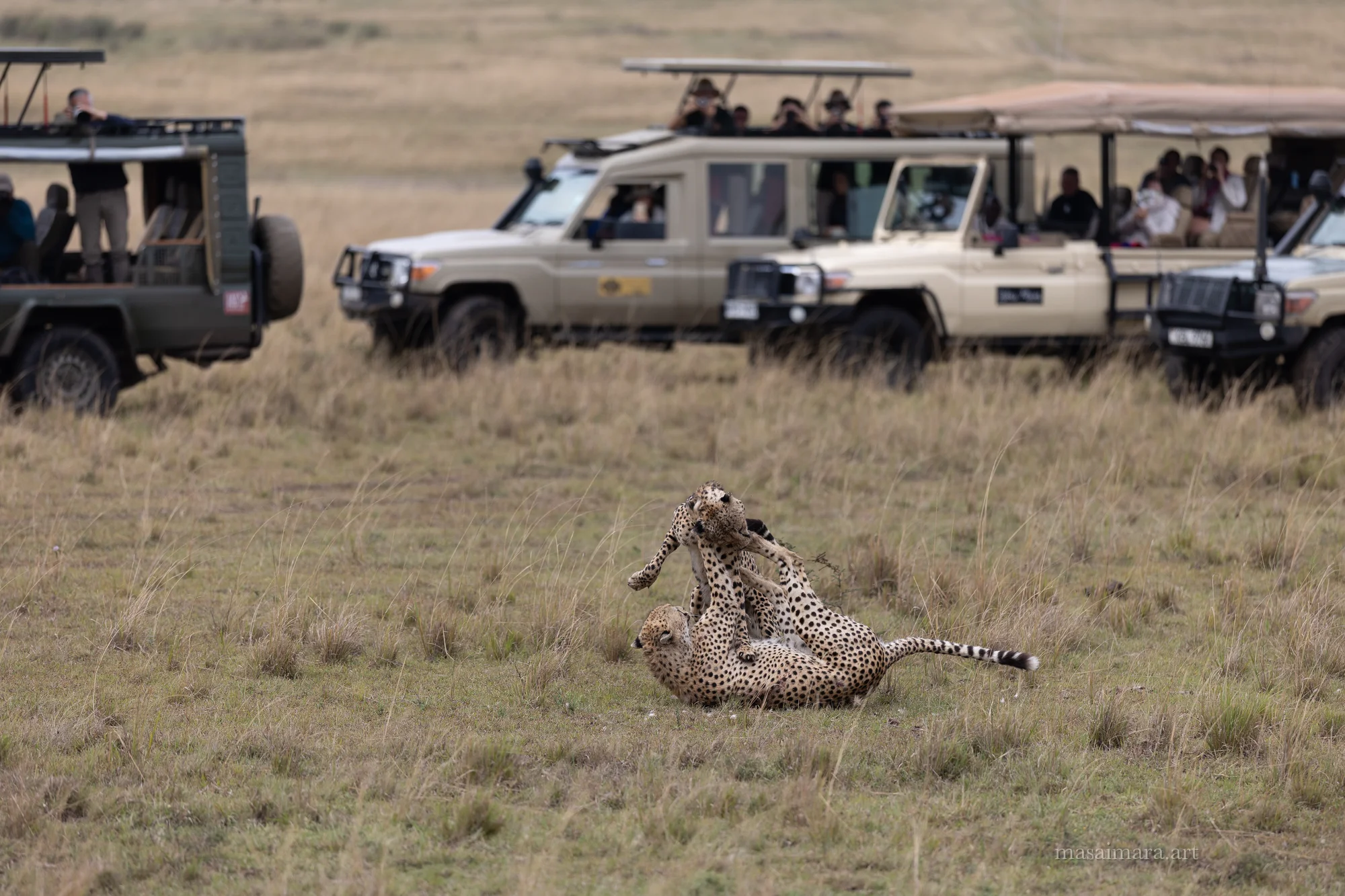
Field note — Two seconds in pale stalks
A driver guide who had worked these plains for ten years had never seen two cheetahs fight. Two of them, in pale stalks at hard midday — thirty metres of grass between, heads up, nothing decided — then the second cat broke from the right, running hard, and the first lifted her chest off the ground with ears back and mouth open in warning. Two seconds later they were down in the dust, paws on faces.
"Ten years," he said, not lowering the binoculars. "I have been waiting ten years to see this."
The lesson of a cheetah afternoon is that the event you are waiting for has, statistically, never happened in front of the person you are waiting with. The hour is the work. The two seconds are the gift.
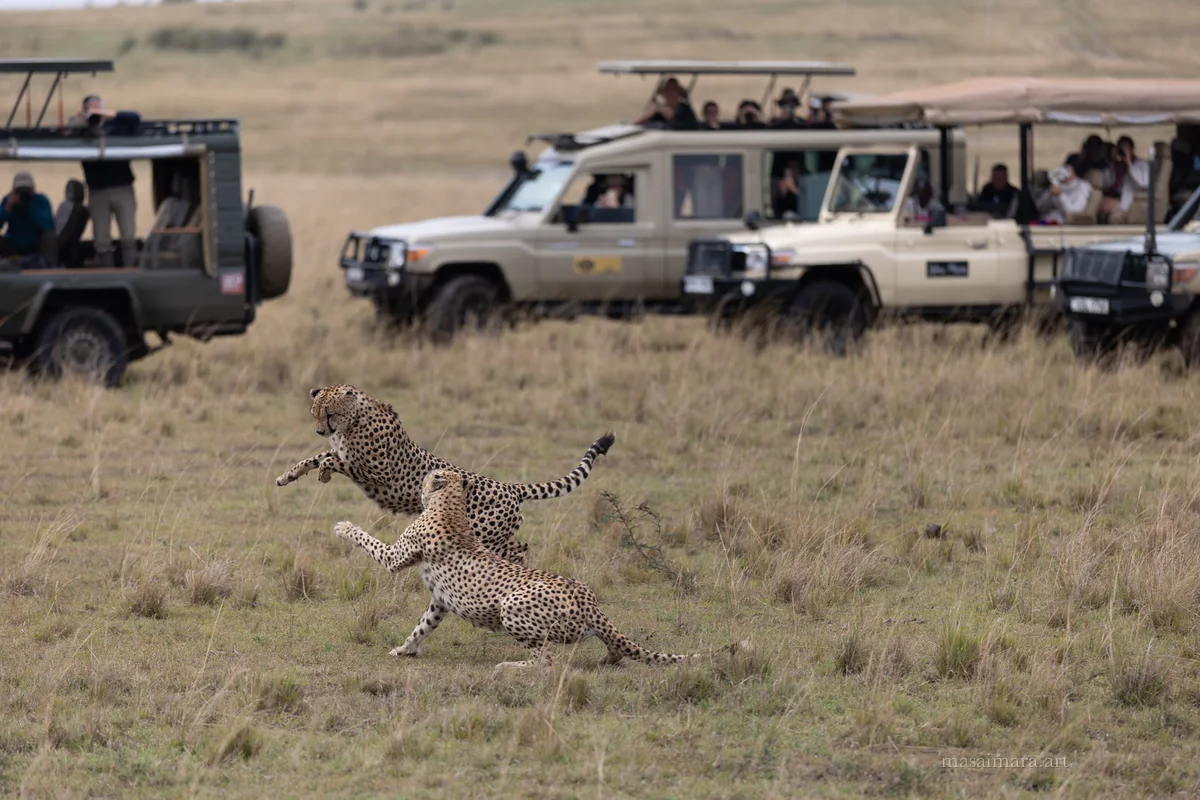
Both cats airborne — two seconds the driver guide had been waiting ten years to see.
The coalitions
Female cheetahs are solitary except when raising cubs. Males are not. A coalition of two or three brothers — sometimes four, sometimes five in extraordinary cases — holds a territory that overlaps the ranges of several females and excludes other males.
The famous coalition of five brothers that worked the Mara plains in the late 2010s, known locally as Tano Bora, were the strongest documented case of cheetah cooperation anywhere in Africa. They hunted larger prey than a solo cheetah could manage — adult wildebeest, eland — and held a territory none of them could have held alone. The smaller coalitions of the Mara today are twos and threes, but the principle is the same. The cheetah is the only cat for which the social unit and the breeding unit are on different sides of the species.
The sentry
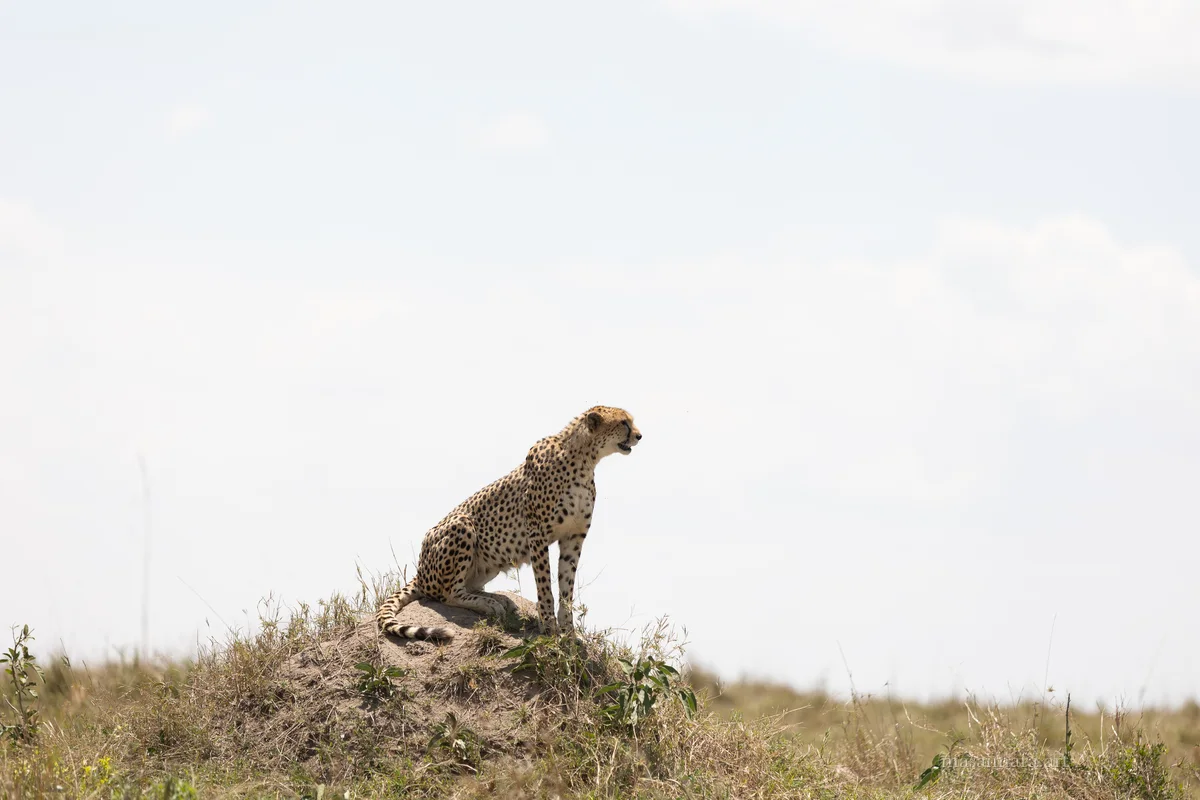
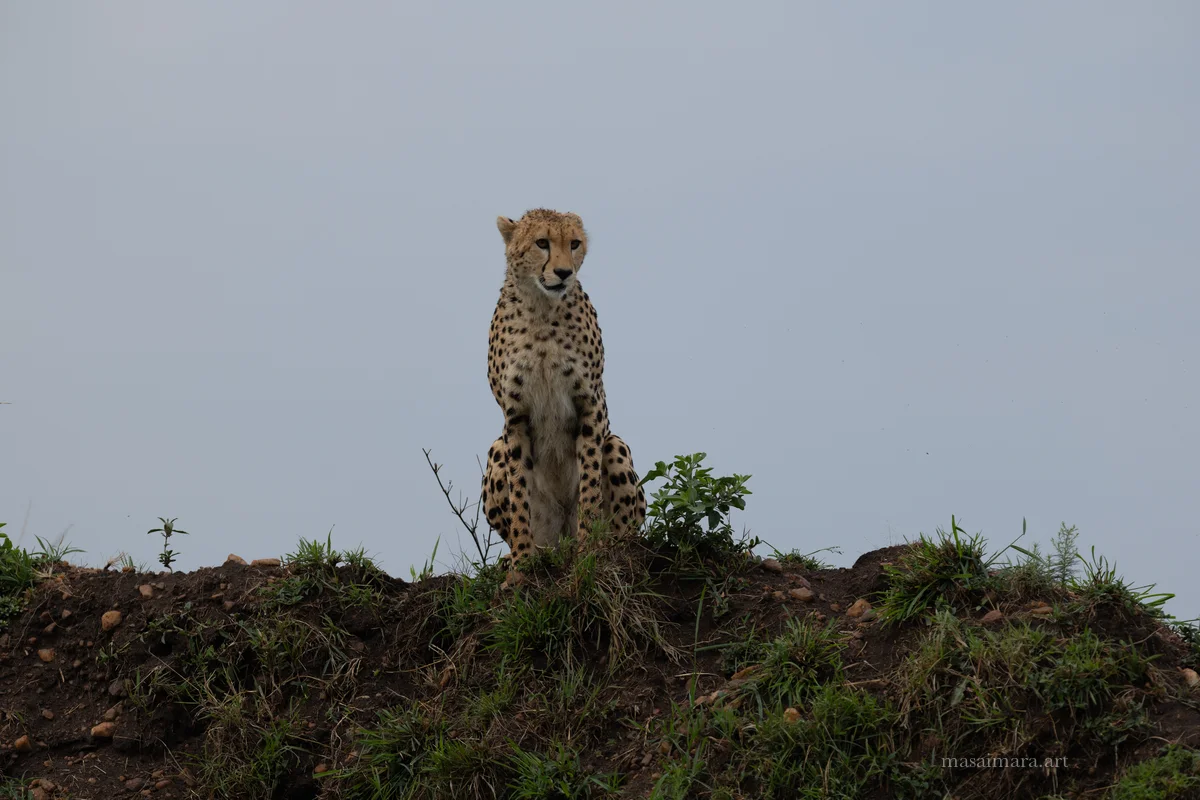
The most cheetah thing a cheetah does is sit. Not lie, not crouch — sit, upright, on a mound or a low rise, shoulders square, ears slightly forward, head perfectly still. The posture is held for ten, fifteen, twenty minutes at a time. From a vehicle at sixty metres it looks like a sculpture. From the cheetah's perspective it is the working pulpit — the angle from which the whole afternoon's hunt is decided.
There is no equivalent posture in the lion or the leopard. The lion sits briefly and then lies; the leopard does not sit at all. Only the cheetah holds the upright sentry, and only the cheetah's life depends on it.
The landscape cat
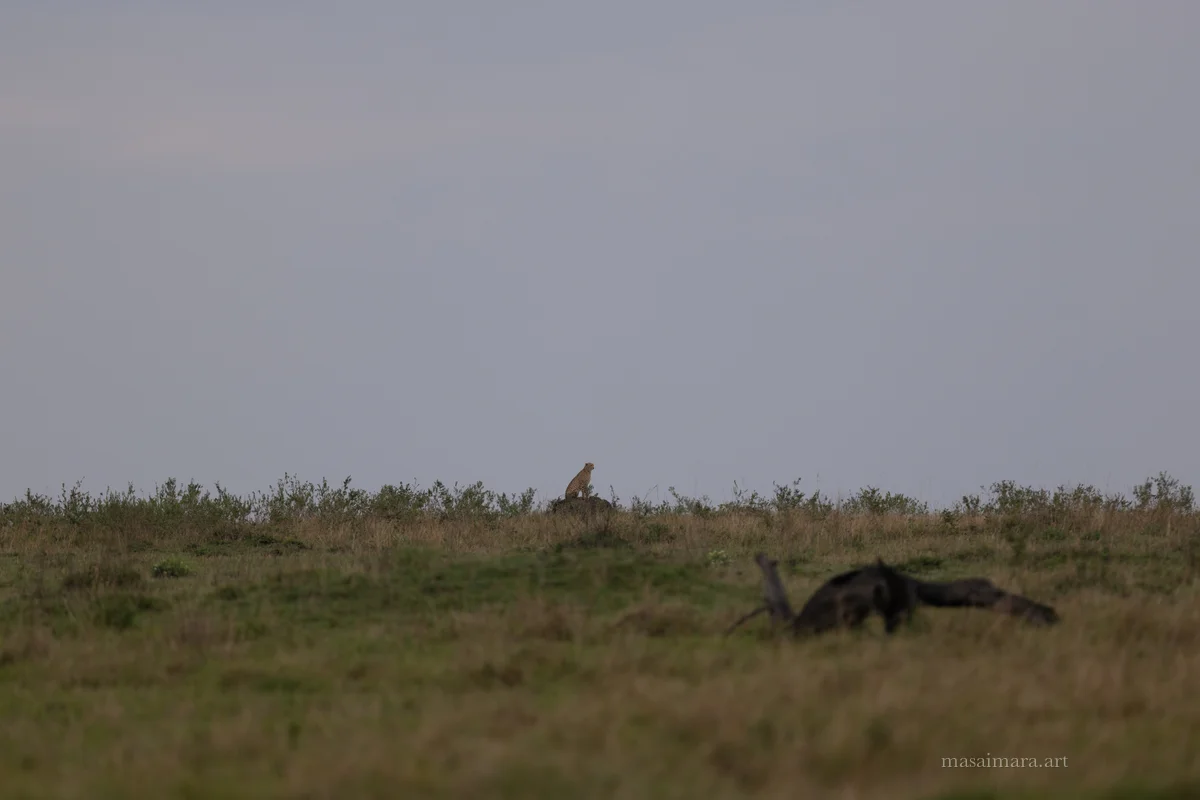
The cheetah is, of all the Mara's cats, the one that most belongs to landscape rather than portrait. The lion fills the frame. The leopard hides in it. The cheetah recedes into it. The strongest cheetah pictures are the ones in which the cat has been allowed to be the smallest thing in her own photograph — a single upright at the top of a slope, a fallen log in the foreground for scale, a distant thornbush behind, and the plain doing the rest of the geometry.
A photographer who insists on the long lens at every encounter will miss this picture. The wider focal length, used patiently, is the cheetah's natural register.
“Most of a cheetah day looks like nothing has happened. The hour is the work.
”
Field notes
The tear-lines
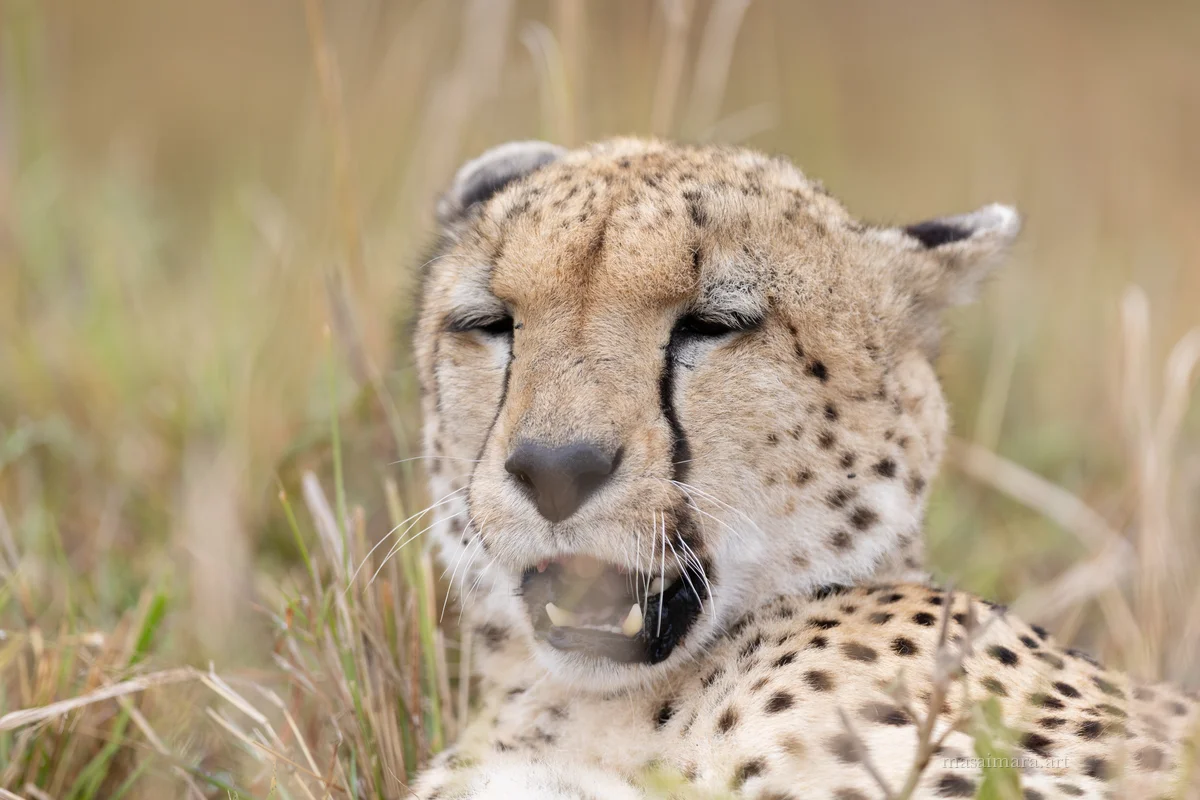
The black streaks running from the inner corner of each eye down to the corners of the mouth are the cheetah's identifying mark — the easiest cat in the Mara to name on a single feature, and a feature shared by no other cat anywhere in the world. The lines are not for show. They reduce glare from the sun the way an outfielder's eye-black reduces it for a fly ball, and they sharpen the cat's vision in the open afternoon hours the rest of the Mara's cats avoid.
The face is the closest the cheetah gets to ornament. The body is built for one purpose — the lightest skeleton of any large cat, the longest legs, the deepest chest. The face is built for the afternoon.
Mound Cheetah
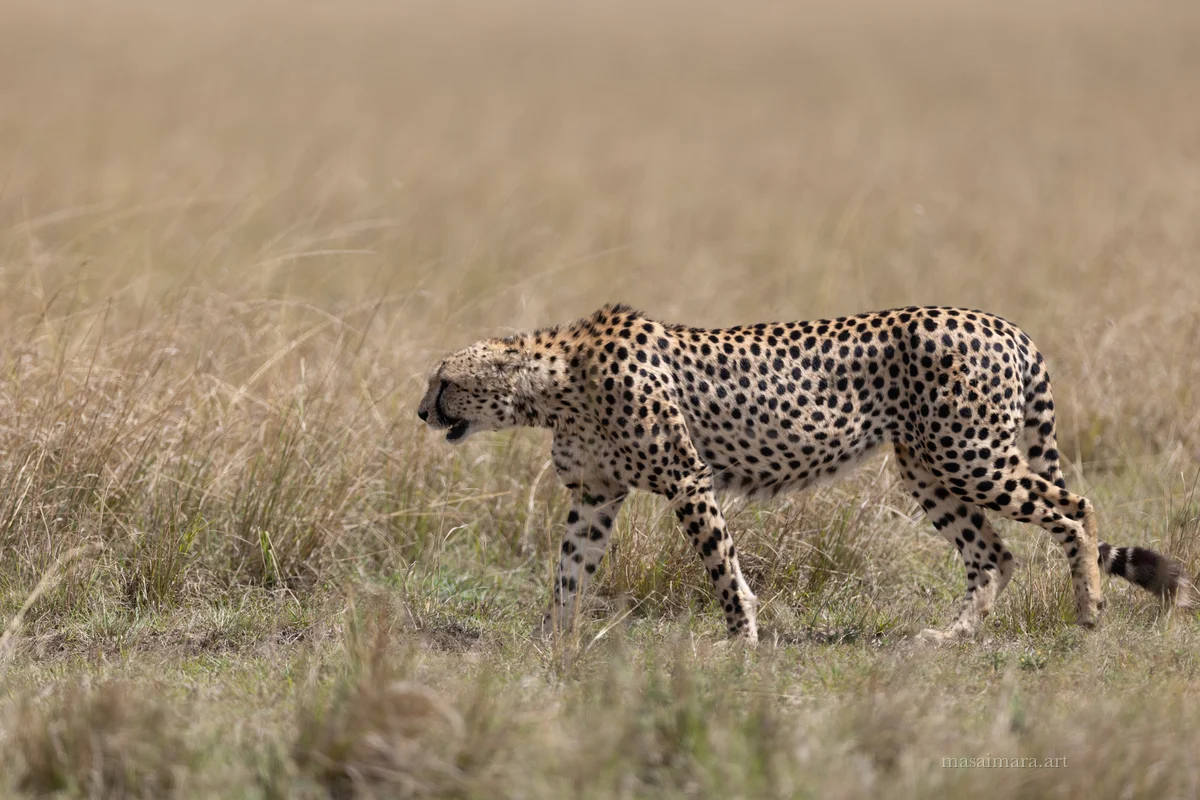
Cheetah Day
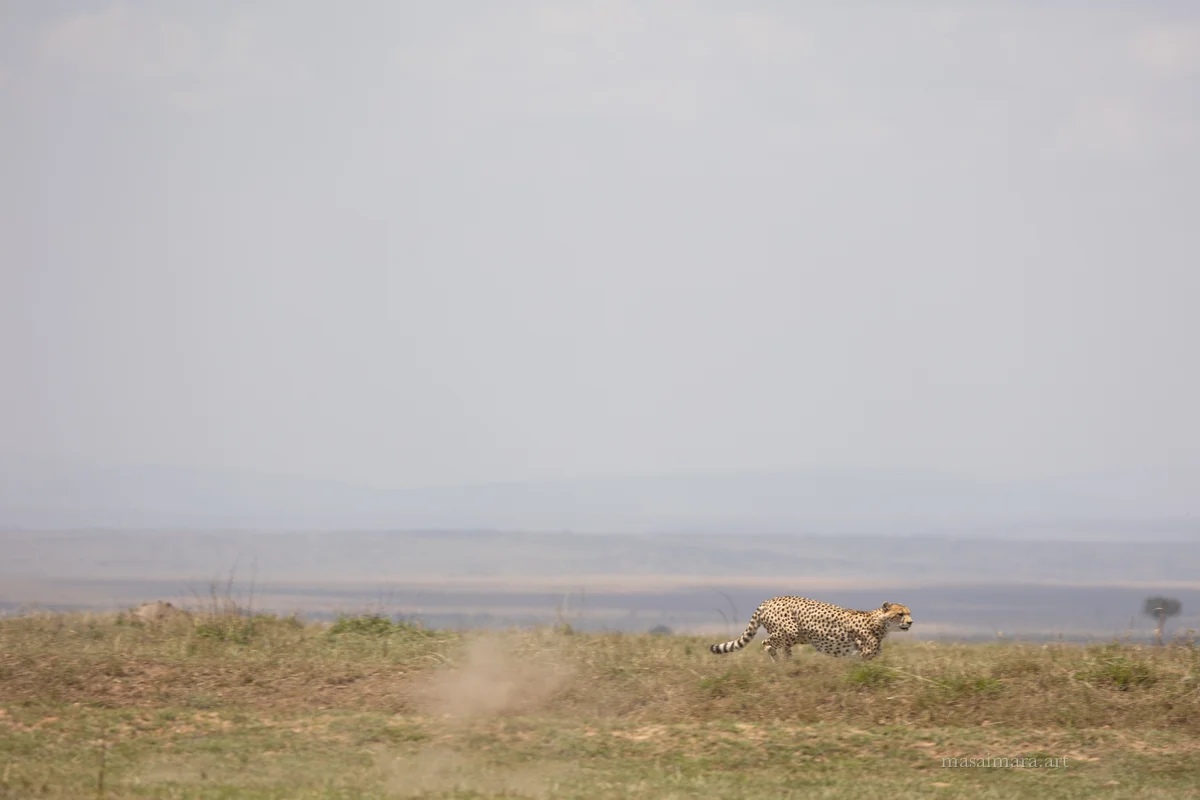
The Sprint
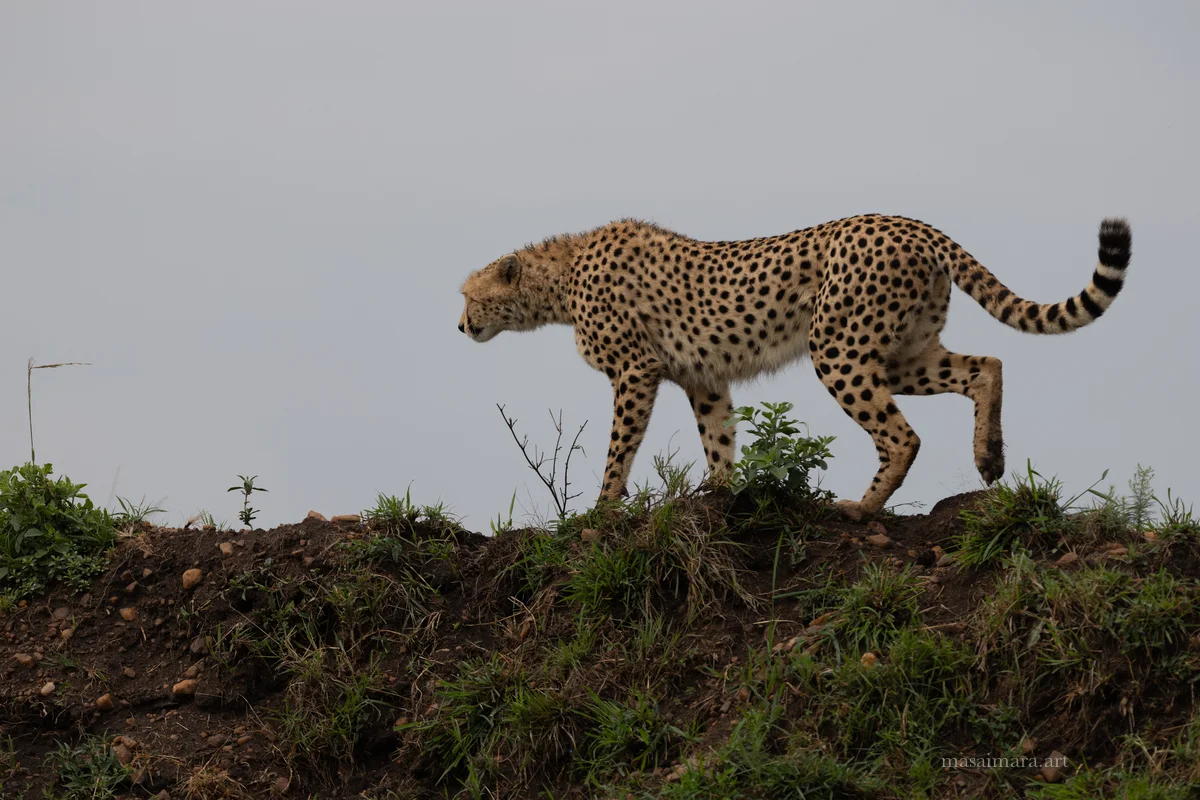
Mound Cheetah
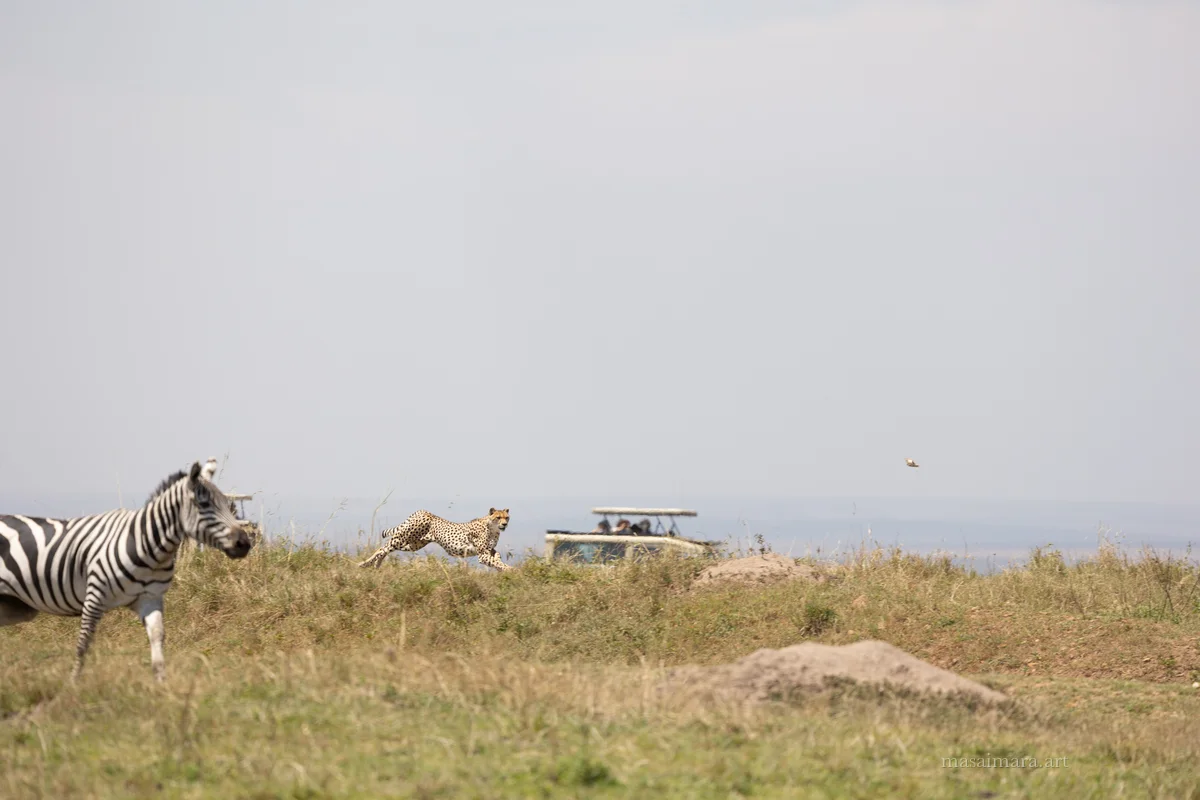
The Sprint
The cheetah is the rare large cat the camera ends up photographing without ever raising the shutter on the moment everyone came for. The mound, the watch, the long afternoon. The picture is the patience.
The cheetah's day is mostly the hour around the picture — the upright sentry on the mound, the long stalk, the two seconds that resolve it. The photographs that earn the species are the ones the camera takes during the wait.
- Camera
- Canon EOS R5 Mark II · EOS R6
- Lens
- Sigma 500mm f/4 · Canon RF 70–200mm f/2.8